
As America Approaches 250: Collinsville History 1850 to 1875
 By the Collinsville Historical Society • The Civil War and the discovery of coal were the most significant events impacting Collinsville during this period.
The war raged from 1861 to 1865. It was a time of tragedy, destruction, sacrifice and hardship. An estimated 700,000 soldiers were killed and an additional 475,000 were wounded. Our young nation was being tested, as were every state and city.
Collinsville was not immune to these losses. The Glenwood Cemetery in Collinsville has approximately 90 Civil War Veteran graves of honor. We will share one story of the war’s impact on one local family – Angeline Penny Beidler, wife of Rev. Frederick P. Beidler. Their story which follows was researched and written by the folks at the Collinsville History Museum.
One of 11 children from a pioneer Collinsville family, she married Rev. Frederick P. Beidler in 1852. During the Civil War, she traveled alone to Washington, D.C. to secure a medical discharge for her ill husband, who was a Sergeant in the Union Army. He and other soldiers had been poisoned from Federal food supplies, mostly flour that has been tampered with by Confederates.
During her four-day trip, Penny stayed at the National Hotel, where she met Illinois Governor Richard Yates as well as other government officials. With their support, she presented her handwritten request to President Lincoln. Lincoln quickly approved Rev. Beidler’s release to her care.
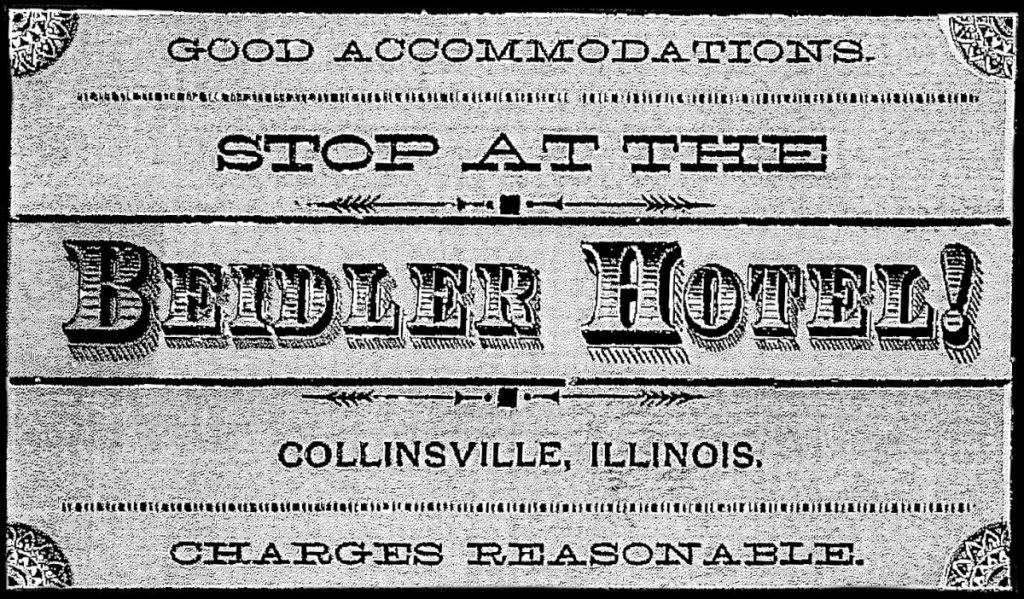
Back in Collinsville, the Beidlers opened their large home on Church Street as a hotel and boarding house. Her home cooking with $0.25 chicken dinners became famous in the area. In the summer, St. Louis families came by train to the station at the bottom of Reed Avenue and walked up the hill to the popular hotel.
Out of the goodness of her heart, she took in young men who needed a place to stay. The Beidler Hotel soon became a stamp of approval for young men.” Irving Dillard
Angeline P. Beidler firsts
- First woman to run for the Collinsville School Board
- First woman on the Presbyterian Church Board
- President of the local women’s Christian Temperance Union
- Member of the Purple Ribbon Society
Penny became a well-known figure in town, generally dressed in black, including black bonnet, high-topped shoes and her black umbrella. She regularly visited saloons, urging saloon keepers to provide groceries, coal, even money for shoes, to the distressed wives and mothers whose husbands had squandered their pay on alcohol.
Rev. Beidler died in 1904. Soon after, Penny sold the property to the butcher, Charley Gindler, and he and his wife continued the boarding house into the 1940s. Penny moved to nearby Norwood Avenue. She died after breaking a hip at age 85 and is buried in Glenwood Cemetery. She was survived by an adoptive daughter, Mrs. Myron Peers.
Order of Discharge of F. P. Beidler
April 25, 1864
Upon the personal application of Hon. W. R. Morrison and Hon. F. C. Beaman, and on the case within stated, which I believe to be true, let F. P. Beidler, within named by discharged.
April 25, 1864 A. LINCOLN
Annotation
[1] AES, owned by John S. M. Glidden, Natick, Massachusetts. Lincoln’s endorsement is written on a letter from Richard Yates, April 24, 1864. “This lady, Mrs. Beidler, visited Springfield to see me in relation to discharge of her husband, but not finding me there, has come to Washington. I have no doubt after hearing her case, that it is one in which the exception may be made, and I sincerely hope that you will grant the discharge of her husband. He is a minister of the Gospel and his education and state of health have not been such as to fit him for a soldier’s life.”
Mrs. Biedler is one of 10 trailblazing Women of Collinsville featured in our newest display at the Collinsville History Museum. What do you think about the Beidlers’ story – Union Army soldier – poisoned by Confederates – not released from military service. A woman, alone, travels halfway across the country by train to support him. She gained political support from Illinois Governor Richard Yates, and personally met President Abraham Lincoln and succeeded in her quest to get her husband discharged from military service.
This Collinsville story represents the whole United States in grappling with the war’s impact. Men left town to fight. Women were required to carry out new responsibilities with the men gone. Some men came home, some limped home and many never returned. Economic hardships were faced throughout the war. Economic development ensued to support the war machine then the peace.
The next most significant event impacting Collinsville was the discovery of coal in 1851. The Wonderly Mine was established in the early 1860s. The Consolidated Mine (often referred to as the Collinsville Mine) opened in 1862. The well-known Lumaghi Mine opened in 1869, followed by the Willborn Mine in 1870 and the Cantine Mine in 1873.
“Under all is the land” is the bedrock lead sentence of the National Association of Realtors’ Code of Ethics. Similarly, under all Collinsville land is coal. King Coal created an economic boom around Collinsville. The mines drew miners and their families. These families needed food, supplies, horses, housing and social support. These needs were satisfied with groceries, hardware stores, livery stables, carpenters, churches, schools and even taverns.
Collinsville’s neighbors deserve mention in this time period. We were inextricably linked to each other by King Coal and our proximity. (Today, we are still united by our Unit 10 School District)
Maryville
While Maryville wasn’t platted until 1900, its history is tied to Collinsville. Carl Lange moved to St. Louis as a two-year-old in 1843. Upon moving north of Collinsville, he became a very successful Maryville farmer and business man. He married Maria (Mary) Krome. They had 13 children and Mary was the village’s namesake. The Donk Brothers Coal and Coke Company mines are well-known today but they were developed after 1875. One in Collinsville and the other in Maryville, opened in 1900 and 1901, respectively.
Caseyville
Coal has also been an economic fuel for Caseyville. Early mined coal was hauled to St. Louis by ox cart and mule teams. Caseyville was founded by, you guessed it, a coal company – Illinois Coal Company. In 1851, railroads connected Caseyville to St. Louis, putting the oxen and mules out of work. The convenience of the St. Louis railroad connection became a potential liability as the Civil War began in 1861. Two thousand Union soldiers from Springfield and Chicago were deployed to camp in Caseyville for two months. The fear was attacks from Confederate sympathizers from St. Louis and beyond via the railroad. These troops were commanded by Captain U.S. Grant from Galena. As you should know, Grant would become a significant player in ending the Civil War.
This article was provided by the Collinsville History Museum in support of the Troy Times-Tribune’s special series about the countdown to the 250th birthday of the United States.
The museum is located at 406 West Main Street in Collinsville, next to the Collinsville Library. The museum is open to the public from noon to 4 p.m. Wednesday through Saturday. There is plenty of parking available. Research sources are available upon request.
We cordially invite the Metro-East public to visit the Collinsville History Museum and learn about who we were and what we did in the past.
References
http://name.umdl.umich.edu/lincoln7
Cite this Item
“Collected Works of Abraham Lincoln. Volume 7 [Nov. 3 1863-Sept. 12, 1864]. In the digital collection Collected Works of Abraham Lincoln.
https://name/umdl.umich.edu/lincoln7. University of Michigan Library Digital Collections. Accessed Aug. 13, 2025.


