IDOT hosts another public forum on widening US 40 through Troy
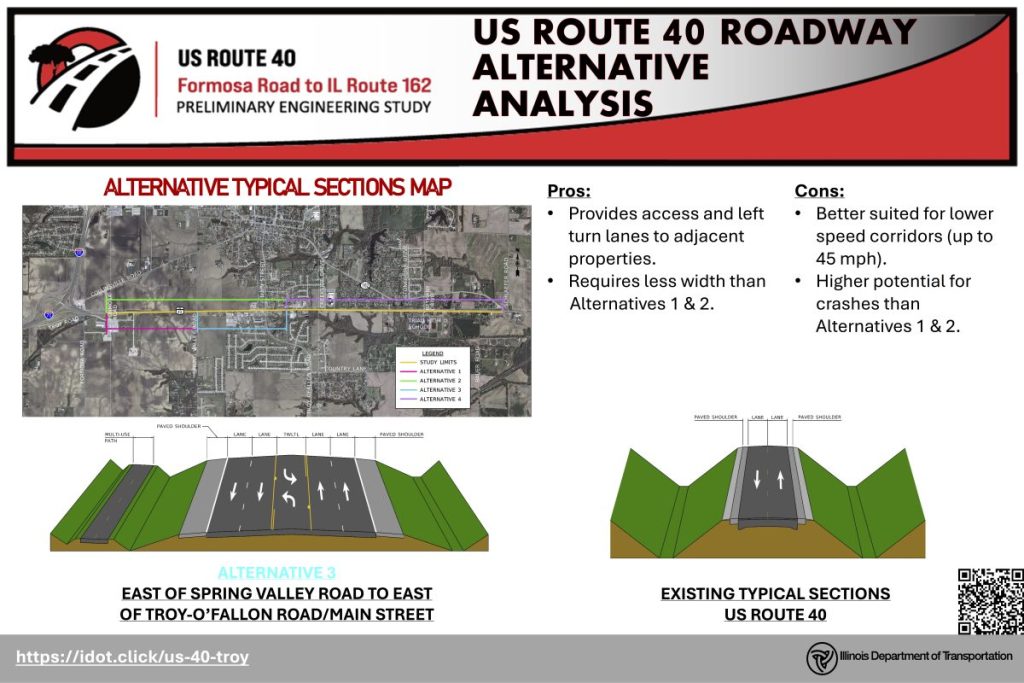
A closer look at IDOT’s third of four options for widening US 40 through Troy (image courtesy of IDOT)
By Charles Bolinger
Editor • Some Troy residents, business owners and visitors experience the delays five days a week. Westbound, drivers want to access Interstate 55-70. Eastbound motorists are trying to turn left to drop off children at Henning Elementary School and/or turn right to get into Triad High School. The problem? Four miles of US 40 creates bottlenecks as it passes east-west through Troy’s southern section.
IDOT officials rented Henning Elementary School’s cafeteria June 29 to show off the latest options, answer questions and gather feedback on the four options they have come up with to date for the highway, which is two lanes from just east of Formosa Road all the way through town and beyond.
Troy officials said this year that the city is averaging 100 new homes annually. That translates into about 200 new cars per year, assuming most households have two vehicles each.
“The City of Troy’s position has been consistent – we would like to see five lanes from Formosa to Route 162,” said City Administrator Jay Keeven, who attended the meeting. “This would allow for two lanes in each direction and a center turn lane for current and future development. However, we understand right-of-way and fiscal constraints. Troy staff is confident IDOT will design this roadway with an eye on safety and efficient vehicular movement.”
IDOT’s options are:
Option #1 would be to widen US 40 from Formosa Road to Spring Valley Road into a four-lane divided highway. The pros of this choice are that it would meet the 55 mph posted speed limit policy; has the potential to reduce serious crashes by restricting oncoming traffic and it offers better traffic flow.
The cons of this option include it comprising the most space; it would require regular maintenance of the grass median and it further limits access to any nearby current or future properties.
Option #2 would be to widen US 40 between Formosa and South Main Street/Troy-O’Fallon Road into a four-lane divided highway with a narrower center median than Option #1. The positives with Option #2 would be that it has the potential to reduce serious crashes by restricting oncoming traffic; it may provide easier left-turn access than Option #1 and it would provide for better traffic flow.
Its negatives are that it may limit access to current/future nearby properties, there could be maintenance issues with the median and it may require storm sewers and increased costs.
Option #3 would widen US 40 east of Spring Valley to a point east of South Main/Troy-O’Fallon Road but not as far east as Henning. The road would be five lanes wide, with the middle one being a dedicated left-turn only lane. Pros: provides access and left-turn lanes to adjacent properties and it would be narrower than options #1 and #2.
Cons: better suited option for lower speed corridors (up to 45 mph) and a higher potential for crashes than the first two choices.
Finally, Option #4 would widen the route from east of Troy-O’Fallon Road to Route 162 but only by adding a dedicated center left-turn lane. The pluses would be that this option would allow access and left turns to adjoining properties. The minuses are that it is the narrowest alternative and could be used as a temporary condition.
A drawback to the final option is that it would provide less capacity since it lacks a double-lane configuration. Note that in all of the above options, the Silver Creek shared-use trail on the highway’s north side would remain and will be extended eastward as a separate project.
Dawn Mushill, president and CEO of the Troy-Maryville-St. Jacob-Marine Chamber of Commerce, attended the forum.
“I thought Volkert [Construction] and IDOT did a nice job laying out the proposed plans for expanding the lanes on 40,” she said. “The increased traffic has become a safety issue, especially during school hours.”
IDOT maintains that the average daily traffic (ADT) volumes as of 2021 ranged from 14,400 vehicles on the west end of the study zone to 8,300 vehicles at Route 162 on the east. Projected ADT numbers are 18,500 on the west end and 10,300 on the east end by 2046.
This was the second public meeting on the project; the first one was in March 2024. As a result of the first public meeting, the project limit was extended eastward from Bethany Lane to Route 162 and now includes Schlaefer Road. There were also two community advisory group meetings that took place in September 2024 and February 2026. Another meeting is tentatively scheduled for this autumn. After that, the project will move into the preliminary design phase.
Visitors were invited to complete comment cards with staff members before they left the June 29 forum. For anyone who did not attend the meeting but wants to share their opinion on widening US 40 through Troy, they can contact Sarah Wiszkon, project and environmental studies engineer with IDOT, at 618-346-3309 or email her at [email protected]
Comments must be submitted by July 17, 2026.
Among the wealth of material provided at the meeting, IDOT posted crash maps along US 40 from Formosa Road to Route 162 between 2017 and 2024. There has been one fatal accident; two front-to-rear crashes that left people seriously injured; 10 sideswipes in the same direction; three in the opposite direction; 69 accidents that involved a vehicle turning with property damage; 10 front-to-rear crashes that left people with moderate to minor injuries; 11 incidences involving turns with moderate to minor injuries; 29 front-to-rear crashes that caused minor injuries; 12 turns that caused minor injuries; 156 front-to-rear crashes that caused property damage; and 69 crashes that involved turning and property damage.