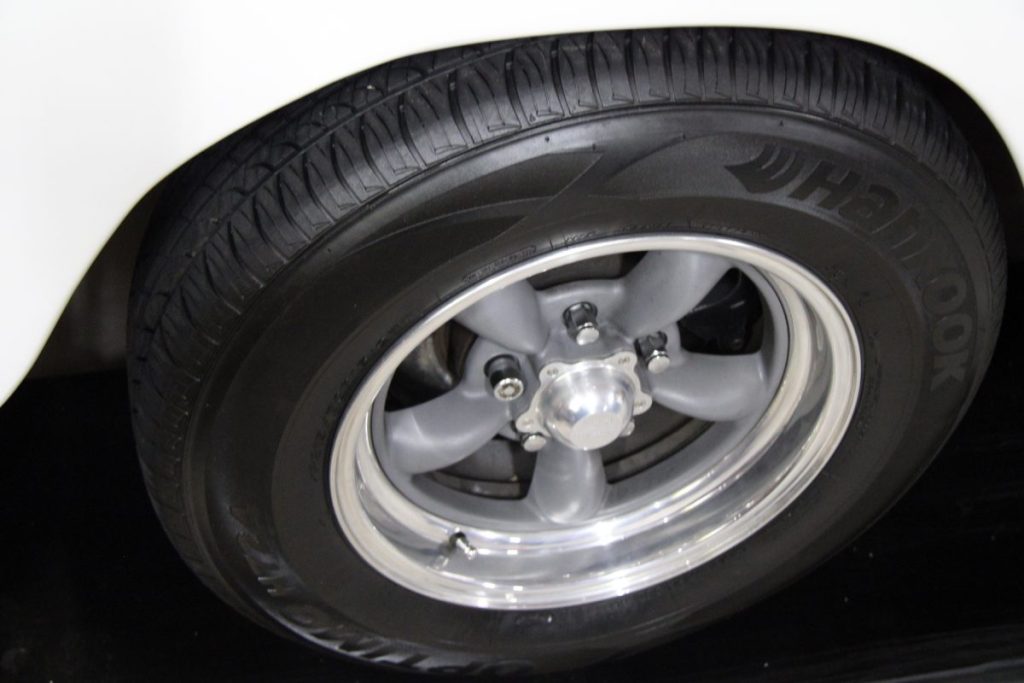
1951 Chevrolet 3100 Pickup Truck: when trucks were trucks
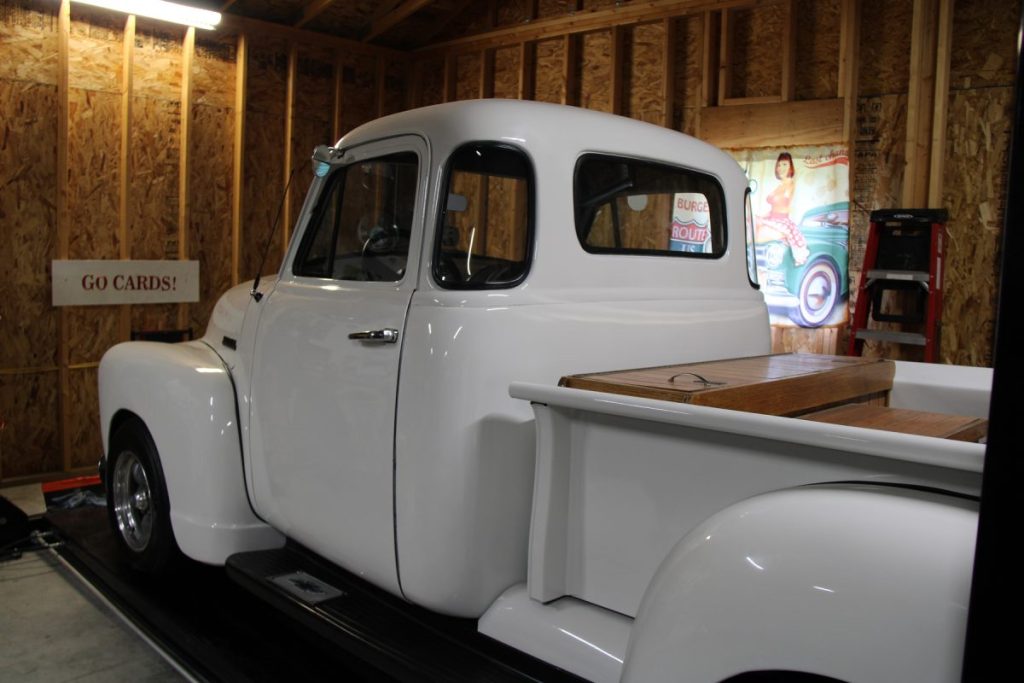
Ernie Huffman’s 1951 Chevrolet 3100 five-window pickup truck. The five-window models are prized by collectors for the left- and right-hand over-the-shoulder rear corner windows. Other models came with just three windows – two side panes and a center rear window. (Charles Bolinger photo)
By Charles Bolinger
Editor • The wait for new trucks after World War II ended was filled with as much anticipation and fervor or more than for new post-war cars. Who wanted new trucks? Farmers, over-the-road haulers and almost any company you could think of in 1946.
By then, thanks to no appreciable civilian supplies, most everyone in the nation drove vehicles from 1942 or earlier. Nineteen forty-six models were mostly warmed-over 1942 models but they still sold to a demanding public.
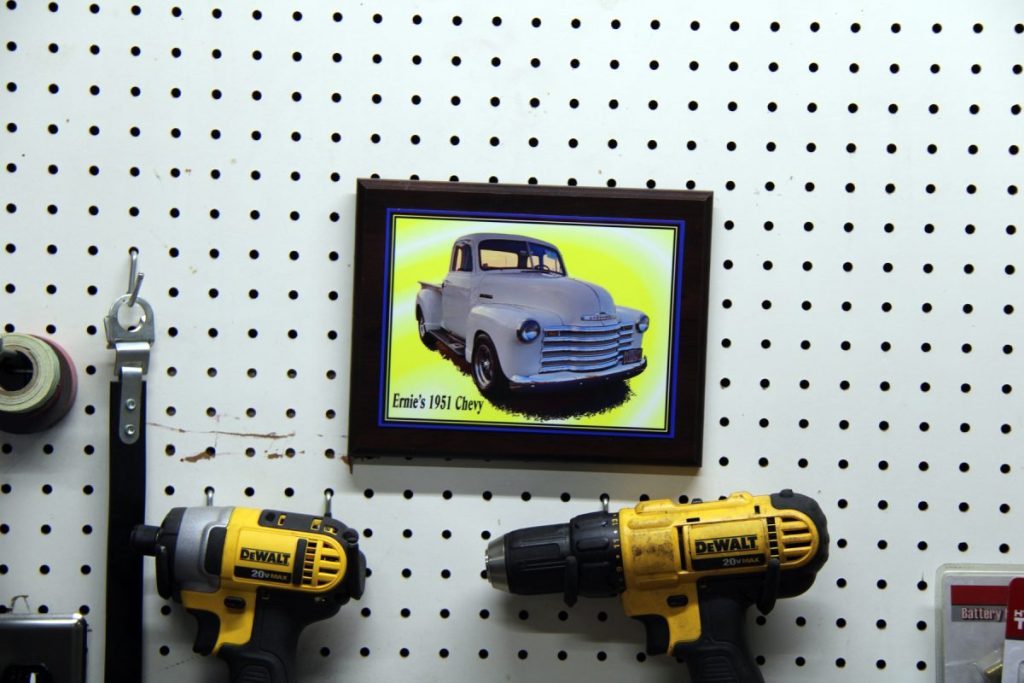
This shot of the truck hangs over Huffman’s workbench. (Charles Bolinger photo)
The first truly new vehicle designs emerged the following model year. Among those was Chevrolet’s and GMC’s Advance-Design light- and medium-duty models for 1947. It was billed as a larger, stronger and sleeker design in comparison to the earlier AK Series. These trucks sold with various minor changes over the years until 1955.
From 1947 until 1955, Chevrolet trucks were number one in sales in the United States, with rebranded versions sold at GMC locations.
Ernie Huffman of Troy has owned at least two of these models, a 1948 three-window model and currently, a five-window 1951 truck.
The truck, like all of Huffman’s classics, is a restomod. It retains most of the classic stock appearance but it has been updated with modern drivetrain and accessories that were not available on most cars in 1951, never mind pickup trucks of that era. The first idea of pickup trucks as anything more than beasts of burden was still four years in the future.
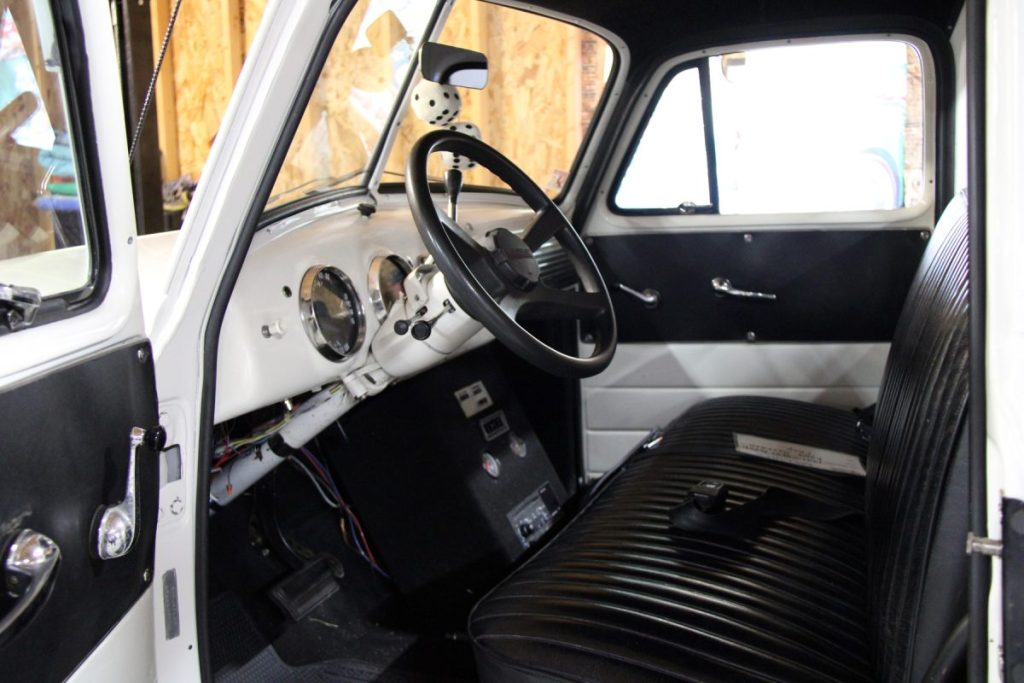
The truck’s black bench seat, floor and center console ar a natural contrast to the white body, dashboard and door panels. Note the four-spoke steering wheel the came from a late 1980s or early 1990s Chevrolet pickup truck. (Charles Bolinger photo)
Huffman said his ‘51 rides on a 1972 Chevrolet pickup truck frame. It has a 350 CID Chevrolet small-block V-8 motor mated to a Turbo Hydramatic 350 three-speed automatic transmission. Convenience features Huffman added include air-conditioning, power steering and power brakes.
“I tried to make them comfortable for me, when I built them,” he said of his small rolling fleet.
Model year changes for 1951 include doors with vent windows. A mid-year change was to go from a nine-board bed to an eight-board cargo bed. It was the last year for the 80 mph speedometer, chrome window handle knobs and chrome wiper knobs. New serial number codes were JP for the 1⁄2 ton, JR for the 3⁄4 ton and JS for the 1 ton models.
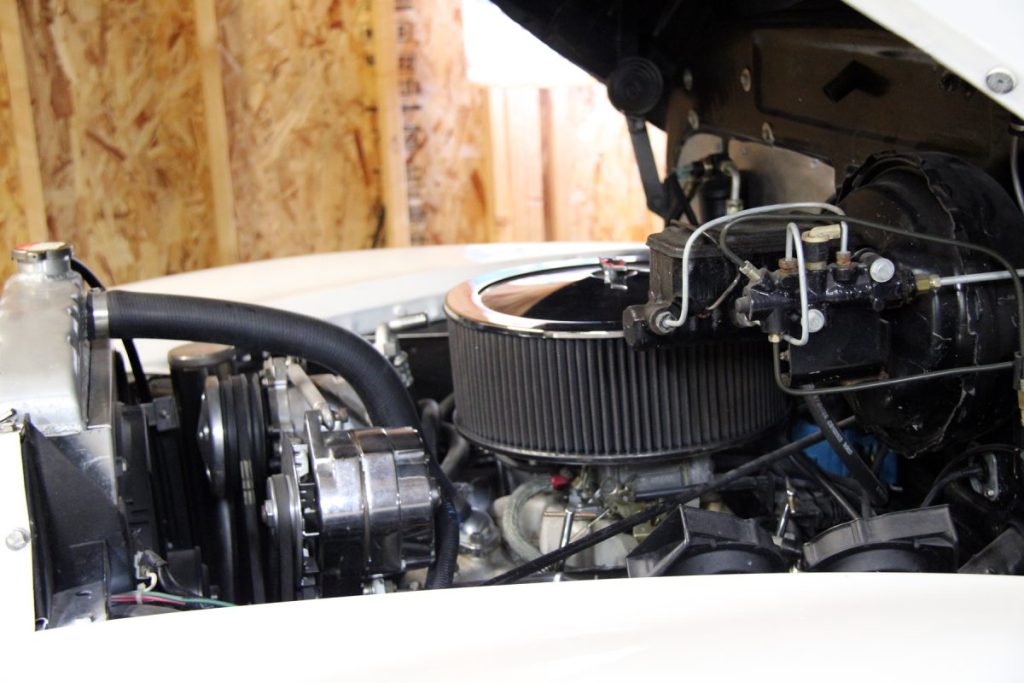
A closer look at the 350 CID smallblock Chevy V-8 that lives in the engine bay of this 1951 3100 Pickup. (Charles Bolinger photo)
He has owned the ‘51 second-longest. He bought it in Imperial, Missouri. There’s a mural hanging in his garage that commemorates the ‘51 truck and one of his two classic cars.
He said Alton artist Michelle Mayden created the mural. The gas station depicted in the mural is a re-creation of a former filling station in Wood River that his father in-law owned. There’s also a framed photo of the truck hanging over Huffman’s workbench.
Huffman said with the number of shows the Lakers have, along with the Piston Pusher Club meeting at the Troy Dairy Queen, he tries to get one of the trio out about every weekend. He also occasionally drives them around town. He said onlookers and passers-by give him ‘thumbs up’ signs.
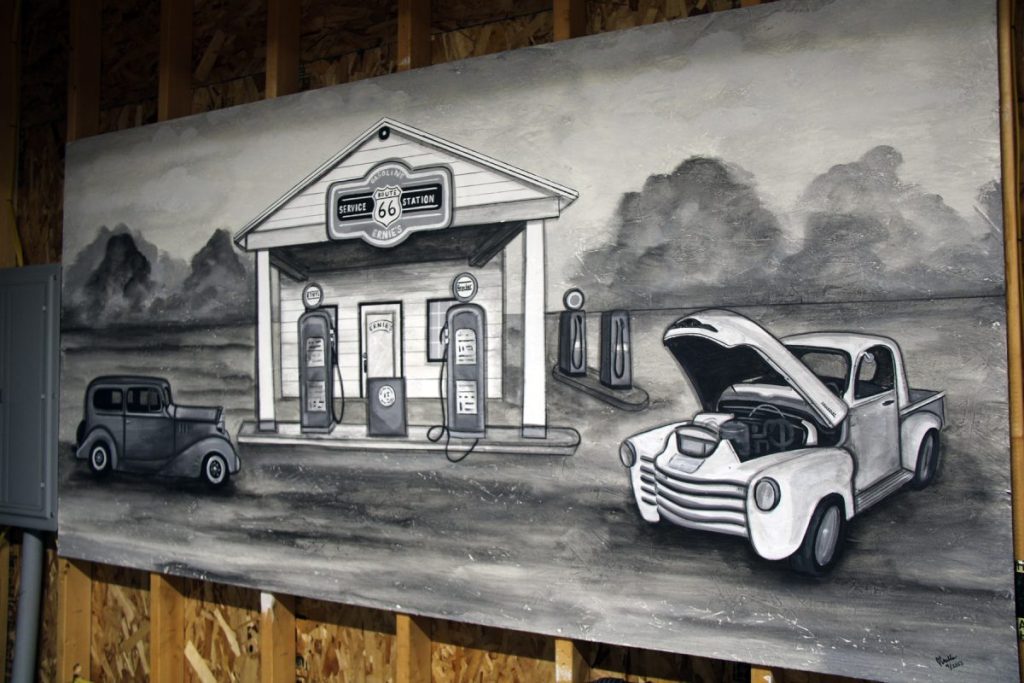
Alton artist Michelle Mayden created this mural that Huffman hangs in his garage. It depicts his father in-law’s filling station in Wood River along with ‘51 Chevy truck and a 1933 Chevrolet. (Charles Bolinger photo)
Huffman is a member of the Lakers Car Club. He has been a member since 2010, he estimates. He’s a former member of the Piston Pushers Club and he befriended Diane and Rocky before Rocky’s passing.
Chevrolet and GMC used the same basic design features for all of their trucks, including the Suburban, panel trucks, canopy express and cab overs.
The cab overs used the same basic cab configuration and similar grille but used a shorter and taller hood and different fenders. The unique cab over fenders and hood required a custom cowl area which makes the cab over engine cabs and normal truck cabs incompatible with one another while all truck cabs of all weights interchange.
While General Motors used this front end sheet metal, and to a slightly lesser extent the cab, on all of its trucks except for the cab overs, there are three main sizes of this truck: the half-, three-quarter- and full-ton capacities in short and long wheelbase variants.