As America Approaches 250: Goshen Settlement (1800-1850)

The Smola-Brockmeier House, built during the 1850s and which is one of the first brick homes built in Madison County.

The Smola-Brockmeier House today. (courtesy of Google Street View)

Jacob Kinder’s Homestead in Glen Carbon, circa 1972. (Nancy Fischer photo)
By Samantha Doolin, Glen Carbon Heritage Museum Coordinator
As America nears its 250th Anniversary, communities across the nation are reflecting on their origins. At the Troy Times-Tribune, it is no different. We, too, are collaborating with local historians and groups on a timeline of articles between 1776 and 2026. For residents of Glen Carbon, Edwardsville and Maryville that story begins just before the dawn of the 19th Century with a name seen on roads, businesses and buildings: Goshen.
In 1799, Rev. Badgley traveled north along the Mississippi River, seeking land uninhabited by the French Catholic communities to the south. What he found was a rolling, untouched wilderness—abundant with plant life and game. Inspired by the biblical “Land of Goshen,” a place of security and prosperity in Egypt, Badgley returned home proclaiming he had found a new Goshen in the American Bottom region.
By May 7, 1800, Congress had divided the Northwest Territory into the Indiana and Ohio Territories. The area that would become Illinois was now part of the Indiana Territory—and soon, it would be home to new settlers inspired by Badgley’s tales.
Among the inspired was Ephraim Conner, who settled in the area between present-day Collinsville and Edwardsville. Though he didn’t hold title to the land, his simple homestead became the foundation for what followed. Enter Colonel Samuel Judy—an Illinois Militia Officer—who arrived with a military land grant and purchased Conner’s cabin. Conner moved on, eventually passing away in 1829. He left his remaining property to Jacob Varner, who is buried at the Nix/Judy Pioneer Cemetery.
Judy and his wife Margaret Whiteside Judy, the daughter of John Whiteside from neighboring St. Clair County, married in 1796. They arrived in the Goshen area around 1801 with their three young children. Upon settling, they expanded the modest cabin and began shaping the land into a thriving homestead.
Col. Judy planted an apple orchard and raised livestock—horses, cattle, hogs, and sheep. He and Margaret also undertook an ambitious project: building a two-story brick home, complete with defensive turrets and attic portholes to protect against Native American attacks. Finished in 1808, it was the first brick house in Madison County—at a time when the county stretched all the way north to Canada.
Religious life soon followed. In 1804 or 1805, a group of Methodists constructed Bethel Chapel from rough-hewn logs with a clapboard roof. The humble chapel became the site of Illinois’ first Methodist camp meeting in 1807, led by Rev. Jesse Walker and Bishop William McKendree, for whom McKendree College would later be named.
In 1816, Bethel Chapel hosted the Missouri Annual Conference, which then included southern Illinois. Though the chapel fell into disrepair by the mid-1800s, its small cemetery still exists today in Glen Carbon’s Lakewood Subdivision.
Before Judy, Badgley, or Conner arrived, the area was already a known animal and Native American trail. That path became Goshen Road by 1808—a vital wagon road stretching from the Judy homestead, down Main Street Glen Carbon, through what’s now Troy, then southeast to the Old Shawneetown salt mines on the Ohio River.
Judy’s growing homestead included a school. Early lessons were taught outdoors, but by 1814, a log cabin schoolhouse had been built. In 1816, Judy acquired four enslaved individuals—two men and two women—to support the demands of a growing homestead and construction. A fifth man, James Suggs, was indentured to him for 12 years.
Margaret Judy died in 1816, leaving seven children behind. The following year, Sam Judy married Sally Reaves. In total, he fathered fourteen children between the two women. When Sam died in 1838, he was not given a headstone. Two of his daughters, Neomy and Martha, died in 1849 during the cholera epidemic that cost Madison County 163 people in four months. That year, Sam’s son, Thomas Judy, purchased two headstones: one for his father and another for the girls—costing $24 in total. All are buried in the Nix/Judy Pioneer Cemetery at IL Route 157 and Chain of Rocks Road.
Alongside the Judys were many other early settlers, some of which include the Gillhams—Isom Gillham served as the first sheriff of Madison County in 1812; the Reynolds—whose ranks included future Governor John Reynolds arrived in 1807; the Whitesides—relatives of Margaret Judy and old family friends; the Lusk family, who arrived in 1805; and the Good family, who sold the land for Bethel Chapel.
By 1819, Madison County had over 700 families—the highest concentration living in the Goshen Settlement.
Government organization was ongoing. Starting in February 1809, Congress carved the Illinois Territory from the Indiana Territory. That same year, Ninian Edwards was appointed its first governor. In 1812, Madison County was officially formed, and in 1818, Illinois was granted statehood. By 1819, when Edwardsville was named in honor of the governor, the region was bustling with settlers and families. In 1820, Madison County no longer extended to Canada but included parts of Sangamon County and Macoupin County and boasted over 13,000 citizens.
Between 1820 and 1830, portions of the original Goshen Township were transferred to Edwardsville Township. By the 1830 census, Goshen Township ceased to be listed by name.
By the mid-1800s, the Goshen name began to fade, gradually replaced by “Peters Station,” named for German immigrant William Peters. Arriving in New Orleans in 1838, Peters worked in St. Louis as a carpenter before crossing the Mississippi and settling in what is now Glen Carbon.
The great flood of 1844 devastated the American Bottom, submerging much of the land between St. Louis and the bluffs. When the waters receded, German immigrants, like Peters, were familiar with river valleys and resilient farming practices and moved in. They drained swamps, built levees, fertilized with manure, and rotated crops. Many of their descendants still farm horseradish in the area today.
Bohemian settlers followed. Around 1849, Martin Smola and his wife, Ludmila, purchased 40 acres from Thomas Judy and built the Smola home that still stands on IL Route 157 north of West Main Street.
On the eastern edge of Glen Carbon, what would later be known as Mont Station was also developing. George and Isabella Kinder moved there in 1811. In 1814, the Montgomery family arrived. A marriage between Eleanor Kinder and Nelson Montgomery in 1838 united the families. They had eight children and left a lasting impact on Madison County. Nelson and Eleanor built the Montgomery House in 1850, still standing on Old Troy Road.
Nearby, Eleanor’s brother, Capt. Jacob Kinder, built his own brick home using local clay and sun-dried bricks—a method similar to Judy’s house. Kinder had served in the Blackhawk War in 1832 and went on to raise nine children with his wife, Sophia.
In 1847, Thomas J. Barnsback—whose German parents arrived in 1809—built yet another brick home, establishing their legacy in Madison County. Their original name was Berensbach, and they simplified it to Barnsback around 1840. The Barnsbacks would go on to establish Oaklawn Cemetery. In total, Glen Carbon still contains four pre-Civil War homes.
Though the name “Goshen” has disappeared from official maps, it remains deeply embedded in the region’s identity. Whether in the names of roads, businesses, or family lineages, the legacy of this pioneer settlement continues to shape Glen Carbon, Edwardsville, and Maryville more than 200 years after it was first dreamed of as a land of promise.

Nelson Montgomery’s Homestead, circa 2017 (Cindy Rinehart photo)
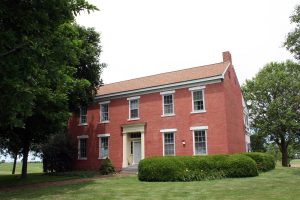
The Thomas Barnsback Homestead, circa 2017. They immigrated from Germany as the Bernesbachs but changed it to Barnsback in 1840.

A lithograph of the Jacob J. Kinder Premises.

A lithograph of the Thomas J. Barnsback Premises, 7.5 miles southeast of Edwardsville.

A lithograph of the Nelson Montgomery Premises.
References:
Cedek, M. J., Foster, J., Harris, L., Raffaelle, J., Smith, J. M., Wiechmann, E. (V.), & Williams, J. (1992). A History of Glen Carbon.
Dickmann, L. F. (1999). A History of Peters Station.
Madison County Historical Society. (2017, July). The Pre-Civil War Homes of Mont Station. MCHS News, 5(4).
Mt. Vernon Register-News. (1949, September 17). Route of the Egyptian Pioneers—The Goshen Road. Mt. Vernon Register-News, 29(304).
Baldwin, C. R. (1978). Echoes of their voices: A saga of the pioneers who pushed the frontier westward to the Mississippi. Tiger Rose Publishing Co.