
Tales from ‘another’ Kahok high school basketball team
 By Roger Reeves
[email protected]
In 1976, Frank Pitol wrote a comprehensive book of the Col- linsville High School (CHS) basketball history. Frank’s entire life was inextricably tied to Collinsville (Township) High School. Further details of Frank’s rela- tionship with CHS would require a book in itself. The name of Frank’s book was “The Wonderful World of Collinsville Basketball.”
It is likely that few of you have read this book since it was published 50 years ago. Frank’s “worldview” at that time was obviously the Kahoks of Collinsville, Illinois. Frank would have had no way of knowing what was happening halfway around the world. But that is our story.
Let’s set the stage. After WWII, there was a U.S. military base in Japan. Up to 500 Naval and Marine personnel were stationed at Sasebo Naval Base and thousands more visited for vessel maintenance. The base had a high school for the children of the personnel, which also included middle school-aged children. There were only about 40 total students, so team sports were a challenge. A baseball team, for instance, was totally impractical. These children had few opportunities to take advantage of social outlets that their state-side peers had.
In 1957, the school principal reached out to the base and asked if anyone would like to create and coach a basketball team. A 20-year-old Seabee stepped up. It was Petty Officer Third Class (PO3) Ed Layher. Layher ran a maintenance organization of 63 Japanese workers. Three interpreters made it possible. Layher said his group maintained everything from Jeeps to D-8 Caterpillars. It is not a surprise that under Layher’s graduation picture in the 1955 yearbook it reads, “liked for his friendly manner and especially for his knowledge of machines.”
Layher collected a team, set up practices, gave the team a name and jersey colors and found competition at other military bases and Japanese high schools. Cheerleaders showed up and a mother coached them. Slick, brand-new jerseys and warm-ups came out of nowhere. Parents jammed the little high school gym. Base personnel started at- tending games and cheering on the ‘home team.’ Some games were played in the much larger base gym. Exciting trips by train were made for away games.
How did Layher start this chain reaction of creating a ‘team’ and a community rallying point of pride? He had a secret. Layher was a Kahok from Collinsville. Ed had played on the ’51-’52 Collinsville High Freshman Team. Layher experienced later ankle problems that ended his CHS playing career. But, in that one year, he learned skills, organization, teamwork and leadership. These were the Sasebo Kahoks in their classy purple and white uniforms.
Now, let’s read some recollections from three of the five starters on the 1957 Sasebo Naval Base Kahoks. Research only reveals facts. From the people who were there, you will hear about emotions, growth and unity. You will also hear about skill improvement, defensive adjustments and community pride.
Hal Amerau was a sophomore who lived with dad, mom and a sister.
“At the age of 14 (in June 1956) my dad, a naval officer, was transferred from Boston, Massachusetts to Sasebo, Japan,” Amerau began. “Sasebo was a relatively small city in Southern Japan at the time, but was a major ship repair facility for the Japanese during WW2. It had one of the largest dry docks in the country and a well protected natural, deep harbor. Nevertheless, Sasebo had a very large U.S. Navy contingent and was a port of call for most of the Navy ships deployed to the Far East.
“I entered Admiral E.J. King High school (named after the Navy Chief of Naval Operations during the war) and I experienced two culture shocks: the first, was of course the displacement from Boston to Sasebo, Japan…no explanation needed, I’m sure. The second one was the ‘High School’ consisted of around 40 students (20 boys/20 girls) and 3-4 American teachers. The student body was a very diverse group from all parts of the country, the Philippines and some Samoan Islands… all “Navy Juniors” i.e. sons and daughters of active-duty Navy personnel stationed at Sasebo.
“For after-school activities, we were limited to the Teen Age Club on Friday and Saturday nights and the Base Movie Theatre. A very nice Base swimming pool was available during the summer…that was it…no clubs or athletic teams for after school activities.
“Now to basketball: at the start of classes in September 1956, the high school was informed that a base sailor, Ed Layher, had agreed to organize and coach the boys’ basketball team. We met Coach Layher shortly thereafter. He didn’t appear to be much older than the two senior boys. I recall around a dozen+ boys showing up for our first meeting. I think [that] three of us had played some sort of organized basketball in the States such as CYO, intra-mural, Summer leagues…no high school experience.
The remaining nine or so had no basketball experience at all. Not a problem, said the coach, we’ ll just have some fun. No one knew how far this grand idea was going to go, if anywhere. And there was the beginning of the Sasebo High School Basketball Team.
“Now, instead of hanging out after school we headed to the “gym” for 2+ hours of basket- ball instruction and practice. The “gym” was a very small hall with a stage at one end and a projection room for films on the other end. A backboard and hoop were set up at each end…one in front of the stage…the other directly in front of the projection booth. The size of the actual court was probably 1/2 the regulation size, or smaller. The main issue was that many of our shots were hitting the ceiling…it was that low.
“After a couple of weeks, it was obvious to all that a sea change had taken place among those on the team. Coach Layer was working hard to teach all the basics of basketball knowing that for some it was a real stretch. We were all getting along better in the “Gym” than we ever had in school. We would stay late to practice if we could and some (maybe many) would show up to the “gym” to practice alone or in small groups. We were building a team!
“Coach Layher showed up for practice one day and declared that if we were going to be a team, we needed uniforms… and unveiled the new uniforms that were purple and white with home and away jerseys and purple warmups. On the jerseys was the name KAHOKS. We all thought that the name was related to the name of the school, E.J.King High School. Nope, Coach Layher told us it was the name of his basketball team in Collinsville, Illinois. The Kahoks’ name had migrated halfway around the globe! How Coach Layher was able to fund the new uniforms was a mystery. What wasn’t a mystery was his determination to build a team that the Kahok brand would be proud of.
“Now that the high school had a basketball team with uniforms, it needed cheerleaders. So, most of the girls joined the new cheerleader team (including the Base Commanding Officer’s daughter) and had uniforms made in downtown Sasebo. One of the female teachers volunteered to lead the new cheerleaders and off they went. Now the time after school was filled with basketball and cheerleader practice.
“Next, we needed a team manager and a faculty representative. As a result, the new basketball team spawned an ‘All hands on deck’ evolution, which pretty much took over the focus of the players, cheerleaders and faculty. Next were the parents.
“Our first game was with a Japanese high school in the local area. We played in our ‘gym.’ The gym was packed with students and parents. I don’t know where the refs came from but they were properly attired in referee stripes. I can’t remember who won the game but it was close. I guess you could say we had the advantage since we knew what our shot trajectory had to be to keep from hitting the ceiling…and fast breaks were limited by the visitors since there really wasn’t enough room due to the reduced length of the court.
“Nevertheless, a great time was had by all. The Japanese, who were a little timid at the start of the event, ended with handshakes and smiles. We were all teenagers playing basketball and having fun…and being cheered on by the girls. We actually won our fair share of games in that gym.
“We played a few more games in the gym before Coach Layher was able to move our games to the base gym. Now, the crowed included whatever sailors were available on a Saturday afternoon to watch and cheer on their own local high school team in addition to the entire high school, parents and a good part of the Navy community. We played the base team and made it a game.
“Coach Layher was also able to reach out to other American high schools on our island of Kyushu, the Itazuke Air Force and Atsugi Air Force bases. To play them away mean we had to take a train to their bases, which as probably a five-10-hour ride…something we would not have been able to experience without our basketball involvement. Yup, the cheerleaders also went along with lots of parents as chaperones.
“A Coach Layher Story: Coach was able to get us invited to a tournament of U.S. high schools in Japan, which as hosted at Itazuke. These teams were drawn from high schools with hundreds of students (rather than our 40) and had been in existence for many years. Our first game was against the No. 1 seed. Coach Layher got us together and told us that the matchup precluded us from being competitive in the game if we didn’t come up with a unique strategy. The strategy was to stall, stall, stall as long as we could and to only take lay-ups…there was no shot clock back in those days. We stalled, stalled and stalled some more. The other team had no idea what to do. The halftime score was 8-4 Sasebo! I recall we got a big ovation from the large crowd at halftime having held the No. 1 seed to four points. Unfortunately, in the second half, we made some unforced shooting (probably had less players on their team who smoked cigarettes than ours). Coach told us how we were going to take Atsugi’s fast break and outside shots away from them…we were going to play them in the high school gym (hall). We did…and we won. No fast breaks unless the visiting team wanted to end up in the projection room or on the stage at the other end. No outside shots unless you wanted to scuff up the ball. It must have been something to watch and listen to the Atsugi players complain. But a W is a W and our standing-room-only fans loved it. (The fans had to stand since there were no benches in the gym).
“It was a great year that I know positively impacted many of our lives. The basketball team united its diversified group of players, the cheerleader members, faculty, parents and even the sailors on the base who came to watch us play. It was the focal point for the gathering, cheering, celebrating and participating in something that had unified the entire base and created an acknowledgement that the team concept was bigger than what we were doing as individuals…and everyone knew that it was all due to the dedication and efforts of Coach Layher, who as a young sailor, was able to bring an entire forward-deployed naval community in Sasebo, Japan (only 10 years after the war’s end) together as a result of his love of his high school in Collinsville, Illinois. He can be very proud of his Kahoks in Collinsville and his Kahoks in Sasebo, Japan, halfway around the world from Collinsville, who are still playing as the Sasebo High School Kahoks. You did good, Coach!
“It was a really enjoyable memory to rehash my recollections of Ed and the incredible job he did for all of us…and the great memories we all carry of him and the Kahoks. Thanks for the providing me the opportunity.”
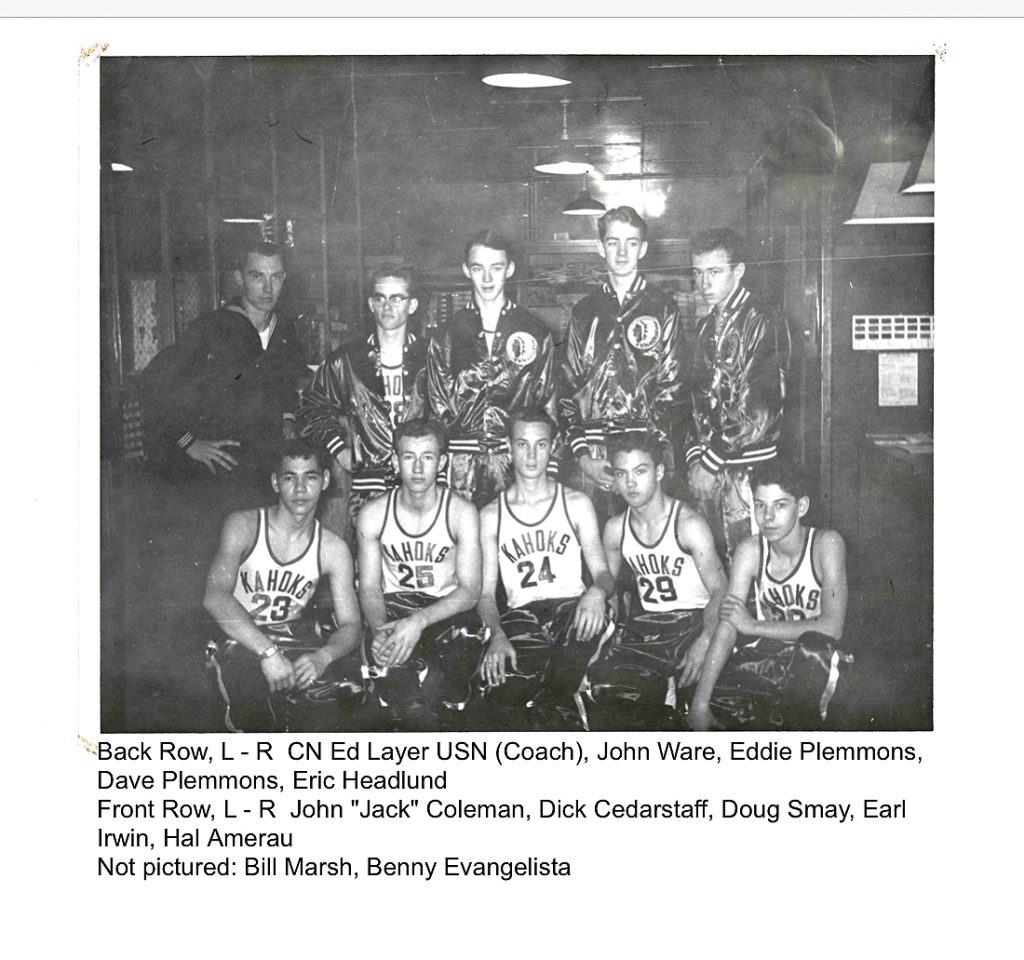
Dick Cedarstaff was a junior who lived with dad, mom, three brothers and two sisters.
“I don’t know how Mr. Layher became the coach of our basketball team,” he said. “As far as I can remember, he was a nice guy and treated us with respect (not a tyrant coach). I do not remember every having any social contact with him other than basketball-related activities. I can only assume that he was responsible for scheduling our games, who we played, when we played and where we played. Looking at the yearbook, I see we played Itazuke a number of times. The only games I remember were the first time we played them (they whipped us badly, 80-31) and the only game we beat them 25-24 was due to Coach Layher’s strategy of playing ball control (there was no such thing as a shot clock back then). We must have had some kind of team party at the end of the season. (Note: the team gave Coach Layer a set of luggage when he was transferred to Guam.) At the beginning of the season, we didn’t have uniforms or a team name, so Layher talked to us into standing up in front of the parents and other spectators before one of our games and plead with them to donate money to buy us uniforms. Well, it worked and I guess Layher procured the uniforms with the money. We had a team meeeting with Layher and after much discussion, referenced a name for the team. We chose the name “Kahoks” in honor of coach’s hometown basketball team. I’m afraid I can’t really add anymore except that everyone liked Ed. Years later, at one of our class reunions in Las Vegas, Ed and his wife attended, much to our surprise. We talked and hashed over old times in Sasebo and all-in-all, we had a very good time.”
Doug Smay was a sophomore who lived with dad, mom, three brothers and a sister.
“My recollection of Ed Layer includes the fact that he volunteered to spend many hours of his free time to provide a bunch of military dependents a chance to play basketball,” he said. “The only thing most of us knew about the sport was that you were supposed to get the ball to go through the hoop. How one was supposed to do that while the other team was trying to prevent it, was a bit of a mystery. Ed taught us what was probably a fairly basic pick and roll offense. It was rocket science to some of us, but we milked for all it was worth, and had a great time competing with teams from other American military bases as well as the occasional Japanese high school teams.
“At six feet tall, I was the tallest player on our team, so naturally I played center. Our point guard, play caller and the most gifted player on our team was clearly Hal Amerau. Ed literally started the team from scratch. We had no team name, no uniforms and with the possible exception of Hal, no experience playing the game. Ed suggested we use his high school’s nickname, the Kahoks from Collinsville High School in Illinois. We even duplicated the Collinsville team colors. But, of course, we had no uniforms. Ed helped us with that also. The school had no budget for uniforms, but through bake sales and other fundraising activities we were able to raise enough money to buy duplicate Kahok uniforms.
“Ed organized our practices, taught us everything we knew about basketball, and was our coach for the first year of our existence before he was reassigned by the Navy. But he laid the foundation for Kahok basketball at E.J. King High School in Sasebo, Japan.
“Most of the girls in the high school participated as cheerleaders at one time or another, but the squad changed from year-to-year as did the uniforms. The high school in Sasebo was named the E.J. King High School after Ernest Joseph King, a fleet admiral in the United States Navy who served as Commander in Chief, United States Fleet and Chief of Naval Operations during World War II. The school building looks rather impressive from the outside, but don’t be fooled. The high school occupied very little of it. On the ground floor, the left wing of the building was a bank and the right wing was a library. On the second floor, the right wing housed the junior high school and the left wing was vacant. The high school occupied only the top floor. Class rooms were in the right wing and the “gym”, a renovated theater, was in the left wing. The theater had a stage at one end and a projection room at the other. The project room was turned into a shower room.
“The entire building has since been torn down and a new E.J. King high school has since been built. The team name has also been changed to the more appropriate King Cobras!
“We weren’t a high scoring team in 1957. The most points we ever scored was 77 against a Japanese high school. But our usual scores were in the 30s with an occasional 40 or 50 point game. And that first year we lost more than we won. Our over record was 5 – 15.
“My own overseas adventure actually began on the island of Guam. Our family moved there for my dad’s deployment in 1956. I attended George Washington High School in Agana, Guam. After nine months on Guam my dad’s unit, a Seabee Cargo Handling Unit, was transferred to Sasebo, Japan. We spent the next two-and-a-half years there. I loved every minute of it!
“Here’s a bit of trivia for you. While my family was still in Guam I met a girl and dated her a few times. Her dad was in the same unit as my dad, so when we were transferred to Sasebo, she was too. I dated her again for a brief time in Japan. Several other guys dated her, too. She was very cute and quite vivacious and all the guys were crazy about her. Her family was rotated back to the states some time before mine was and I never saw her again. At least not in person.
“At our 1999 reunion in Dallas, I found out that she was the centerfold pinup for the July 1965 issue of Playboy magazine!! I was able to find a copy and so I saw her again, but not in person. On the other hand, I saw a lot more of her in Playboy than I ever did in Guam or Sasebo.”
In 2003, a sports reporter with the Collinsville Herald Journal interviewed Ed Layher. Following is an excerpt of Jason Sibert’s column from May 14 that year.
“Layher can still remember the school holding bake sales to buy the team’s uniform and cheerleaders’ moms making cheerleading uniforms.
The former Kahok basketball player said he got into coaching so kids in the Sasebo school could ‘have the same experience that many other high schools are allowed to have.’
The first edition of the Sasebo Kahoks had just seven players. In their first year, the new Kahok basketball team compiled a 5-15 record. According to Layher, the biggest win of the season was over Itazuke, a tough Japanese squad in the area.
The score in the win over Itazuke was 25-24. Layher said he knew that his team was outclassed against Itazuke, but in practices before the game, he stressed passing, lay-ups, free throws and the screen and role tactics he had learned when playing in the Collinsville basketball program.
In the latter part of the game against Itazuke, the Japanese team was down to three players due to players fouling out. Layher says he can still remember his players throwing him in the shower after the big win.
The original Sasebo Kahok basketball team had a reunion in 1999 in Las Vegas. Four out of seven players, Hal Amerau, Dick Cedarstaff, Doug Smay and Earle Irwin, attended.
A handful of children in a small high school on a large Naval Base half way around the world generated a significant transformation. Hailing from literally all over the United States, they became a cohesive unit that evolved into a rallying point for the base. A tradition was created. Restless boys learned skills, confidence and a sense of unity. Girls joined in to cheer on their guys. Parents took advantage of an opportunity to promote family time. Base sailors had an entertainment option and a ‘home team’ to root for. It is likely some visiting sailors whose vessels were in port for repairs joined the fun.
Ed Layher, the Kahok from Collinsville, was largely responsible for this transformation. To this day Ed has a “no big deal” attitude. He just wanted these kids to have an experience like he had in the states. A Kahok basketball team, wearing the purple and white, continued for two decades at Sasebo Naval Base. You have read recollections from Hal, Dick and Doug. These three men have positive memories of that one year – almost 70 years ago. You can draw your own conclusion about this “no big deal.”
Once a Kahok, Always a Kahok!
P.S.: Ed and Annette Layher, married for 65 years, live not too far from Collinsville. Ed and the three players were generous but strict privacy was respected. So much was shared. Far too much to include. Examples are cheerleaders’ photos, game action photos, other base experiences and military postings but the real story was Ed Layher and the Sasebo Kahoks.


