Triad School District submits balanced budget for third consecutive year
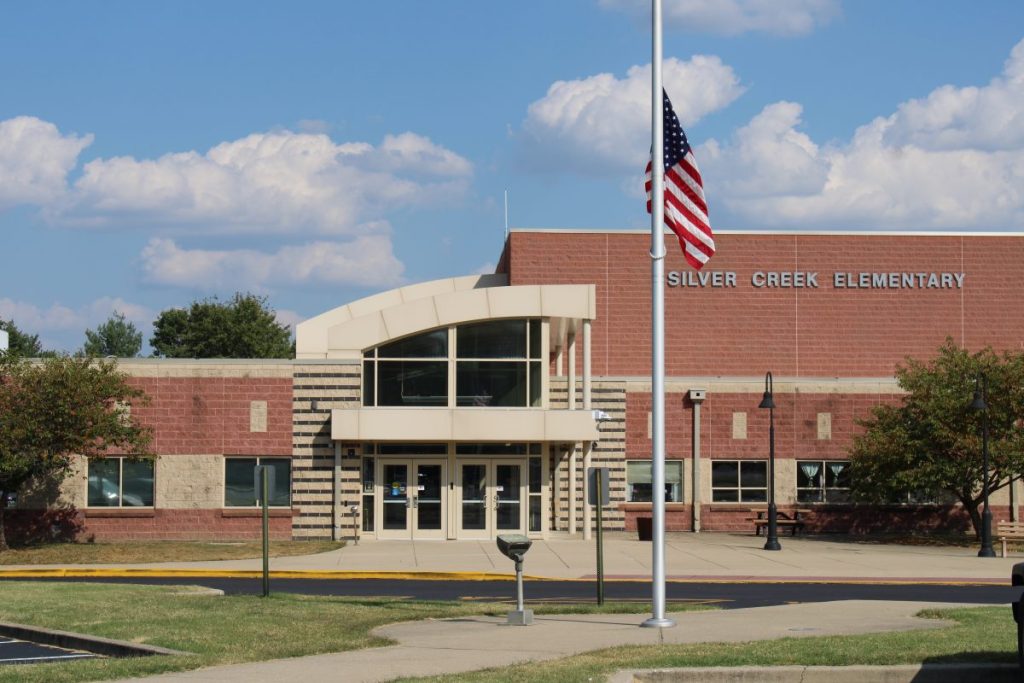
Silver Creek Elementary School
By Charles Bolinger
Editor
For the third school year in a row, the Triad School District will submit a balanced budget to the Illinois State Board of Education (ISBE).
That was one of the takeaways from Dr. Jason Henderson’s budget presentation to the board, faculty, staff and parents in attendance during the Sept. 22 board meeting.
Henderson said one of the program highlights for the 2026 fiscal year, which began July 1, is continuing to support the district’s reading curriculum, “Into Reading” for kindergarten through fifth grade students. This is the program’s second year of implementation.
Another one is to lower class sizes in those areas with the highest number of students and the district will continue to provide electronic devices for all students via new Chromebook leases.
A cursory look at the district’s FY26 budget overview for all funds makes it seem like the district is in the red to the tune of $45 million but Henderson stressed that’s not true. He singled out two funds, debt service and site and construction, as the cause of the illusion. The district’s fiscal year runs from July 1 to June 30 each year.
“This year is a little odd because of the site and construction fund,” he said. “Last year, we sold over $99 million in bonds from our bond referendum that passed in April. So that money went into the bank in June. Now it’s time to start spending that money as these projects start to get built.
“It looks like we overspent by $45 million but that’s because that money is in the bank already,” he said as he walked everyone through the numbers.
The district actually has a small amount in the black from the line, Totals not including construction/bonds or $141,550.
“Really, what the state looks at is our [four] operating funds, which are the education; operations and maintenance; transportation; and working cash funds,” Henderson said. In these, the district has a surplus of $491,650. “That’s a good place to be because we tend to budget very conservatively.”
Henderson then compared Triad to 12 other area public school districts. First was revenue per pupil. Triad received $11,782 per student, second from the bottom on the list. The only comparable district that gets less is Waterloo, in Monroe County. Topping the list was Roxana at $20,365. Collinsville was sixth on the list at $14,747; Edwardsville was ninth at $13,669; while Highland was 10th at $12,786.
Then he showed the other side of the coin, expenses per pupil, using the same 12 comparable districts. Triad again was second from the bottom at $11,143 per student. Leading the way on this list was Belleville at $18,509. Collinsville came in sixth at $14,332; Edwardsville took the eighth slot at $13,824; Highland was 10th with $12,231 and Waterloo spent the least at $10,992.
“We don’t like the fact that we don’t get as much revenue as other schools but we are proud of what you get for what we spend per pupil,” he said. “We like to think we’re every bit as good as any of the schools on that list when it comes to providing an education.”
Next, he talked about the district’s revenue and expenses. Triad receives money from three separate sources, local (62%), state (33%) and federal (5%).
Total local revenue, or property taxes, was $27,575,021 for the 2025 fiscal year. The budgeted amount for this year is $30,612,250, up by more than $3 million or 11% over the previous year.
Henderson said the biggest driver for the increase is that the district’s equalized assessed valuation, or EAV, of all Triad properties rose by almost 12% to $808,313,856. The three-year average is a hike of 10%. The district’s average EAV growth since 2000, when the district’s EAV was $193,395,107, has been 6.07%. The 12% rise marks the 11th year in a row that the district’s EAV has grown following two years of decline.
From Springfield, monies are expected to be mostly flat (a decrease of -0.63% or almost $105,000 out of $16.5 million) from fiscal year 2025 numbers.
The plateau is traced to a smaller-than-usual increase in evidence-based funding plus a larger proration of state revenue in special education transportation and private facilities reimbursement. Henderson another factor is that Chicago Public Schools is now in the same tier as Triad. Last year, the district budgeted $970,000 and received $1.1 million but this year, Triad only budgeted $770,000, or about $350,000 less for special education transportation.
Federal revenue is usually a small contributor to Triad’s budget (5-8%) and Henderson told the audience that is desirable.
“We’re actually kind of lucky at Triad that we only rely on the federal government for a very small portion of our money and that’s a good thing,” Henderson said. “We don’t want to be a district where we rely on 10 or 20 percent of federal revenue; it’s the most volatile of the revenues.”
Last year, $2.3 million was budgeted for while $2.5 million was received. This year, $2.2 million is budgeted or a drop of 9.4%. The largest decreases in federal funding are in Title I (elementary school reading) grant funding, or a $43,306 reduction; IDEA Part B Flow Through, a grant for special education students, which sees a $134,922 drop; and free and reduced lunch program, which loses $17,558.
Finally, other funding sources, such as loans or transfers of interest are a tiny part of the budget. This fiscal year, Triad budgeted for $16,000 in this fund, after receiving $82,340 last year, an almost 81% plunge.
Switching to the expenses side of the ledger, operating expenditures are budgeted to rise almost 7% above the actual expenditures from the previous year. Last year’s actual amount was $45.8 million, after a budgeted amount of $47 million. This year’s budgeted amount is $48.9 million.
For staff and faculty salaries, increases are on the horizon. Total salaries are budgeted to rise by 7.45%. Last year, $30.5 million was budgeted; the actual amount was $30 million. This year, $32.3 million is budgeted. This fiscal year is the third one in a three-year agreement with the Triad Education Association. Certified staff will see a 4% increase in pay while support staff , which are in the first year of a three-year contract, will receive a 7% jump. Five full-time certified staff members have been added, an athletic trainer, a pre-kindergarten teacher, a sixth grade teacher, a high school business teacher and a high school science teacher.
On the flip side, health insurance costs are driving benefits costs to jump nearly 11%. Last year, Triad budgeted $2.5 million for benefits; the actual total came in less than $25,000 away from the budgeted total. This year, the budgeted amount is $2.8 million.
“The cost of health insurance [can be] a killer for any school district but the district is trying to take on more expenses from our employees so we can remain competitive with other school districts [when it comes to attracting qualified faculty and staff members],” he said.
Purchased services, things the district pays others to do are forecast to fall by 5.7%. The largest expenses in purchased services are normally found in food service, special education transportation, technology and operations and maintenance.
Food service costs rise annually, he said, and the expectation is that they will continue to do so in fiscal year 2026. $1.5 million was budgeted last year for Aramark, the actual was $1.53 million and for the new fiscal year, $1.625 million is budgeted, or a hike of $87,989.
The contract with First Student for bus transportation reflects a 5% increase. Last year’s budgeted amount was $1.07 million; the actual amount was $834,151. The budgeted amount for this year was $900,000. The increase is $65,849.
Operations and maintenance (O&M) costs are budgeted to drop 24% this year due to most of the architect fees being paid from the site and construction fund, not the O&M fund.
Supply expenses are predicted to jump almost 15%, or $428,000, due to technology expenses. The district added a second Chromebook lease and computer software subscriptions in general have increased in price.
“We usually keep about 4,000 Chromebooks running at a time and every four years, we recycle about 1,000 of them,” Henderson said.
Within the operations and maintenance fund, Triad is experiencing the same utility hikes as everyone else for electricity usage. The district budgeted $525,000 last year for electricity but used $534,078 worth. This year, $567,000 has been budgeted for utilities at all Triad facilities.
“As you know from your own power bills, those are going up. It’s no different for schools,” he said but he admitted that the buildings equipped with solar panels have been able to blunt some utility costs.
Capital outlay expenses are expected to go up, too, by almost 12%. $3.2 million was budgeted last year; the actual monies spent last year was $2.9 million; while $3.2 million was budgeted again for the new fiscal year. These are fixed assets like equipment, technology, infrastructure and furniture. The district’s largest capital expenses are usually for new school buses, maintenance projects and technology equipment.
In the education fund, Triad is replacing many of its Promethean Boards, which have reached the end of their service lives.
In the O&M Fund, there are multiple maintenance projects, $396,534 worth, related to Knights’ Crossing’s renovation that will be completed by January 2026. This caused a jump of almost $400,000 in this fund over last year’s $528,466 total or $925,000 budgeted for 2025-2026.
Finally, expenses from “other objects” comes mostly from tuition payments for outplaced IEP students. Last year, $1.3 million was budgeted for this, $1.1 was spent and $1.4 million has been budgeted for the new fiscal year, a 17.5% hike from the actual amount spent last year.
About 73% of the district’s budget for the new fiscal year consists of salaries and benefits for the employees, which number more than 550.
The final category is Other Objects. It had a budgeted amount last year of $1.3 million; actual total was $1.1 million. This year, the budgeted amount is 17.5% higher, or $1.4 million.
“If there’s an individualized education program (IEP) student who we cannot educate at Triad, then we have to pay for them to be educated someplace else and that comes at a very high expense in most situations,” Henderson said.
He wrapped by telling the audience that going forward, the district will keep parents, students, staff and faculty informed about the bond issue construction progress; they plan to meet with Madison County officials in October to discuss future equalized assessed valuation (EAV) growth; and develop multi-year revenue projections for future planning.