Troy Senior Center goes to dogs as local K-9 unit visits
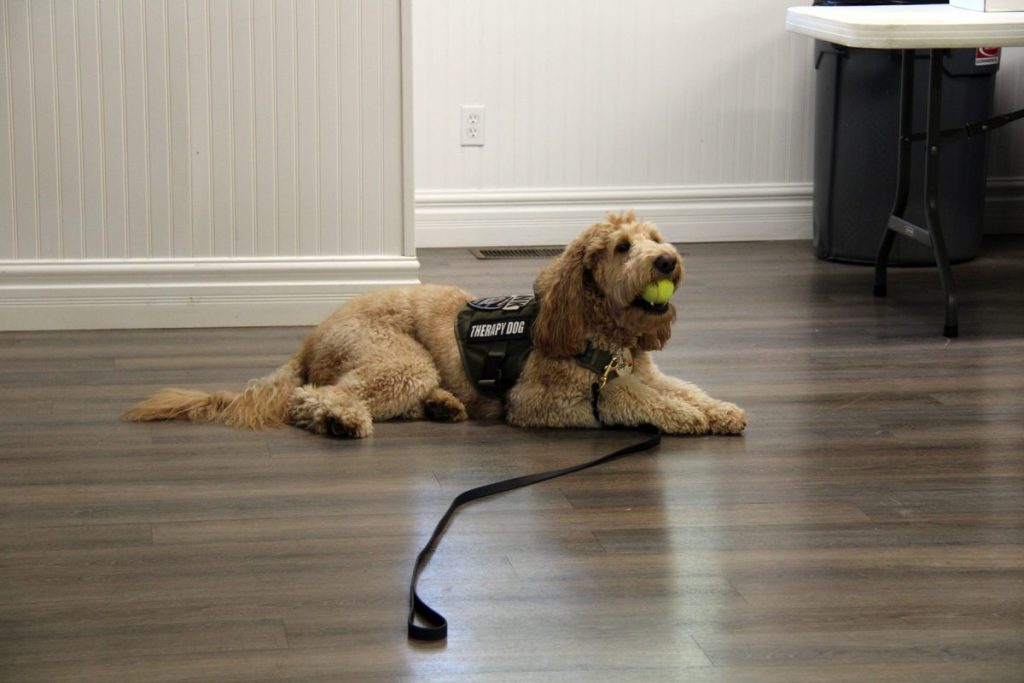
Hank, a 2-year-old Goldendoodle, works as a therapy dog for the Troy Police Department. Here, he has his much sought-after reward, a tennis ball. (Charles Bolinger photo)
By Charles Bolinger
Editor
Pawsing the regular action at the Troy Senior Center, four dogs high-tailed it over there on Sept. 25 for a visit with the humans, though they were kept on a tight leash.
First was Hank, a two-year-old Goldendoodle who has been trained as a therapy dog. Hank has a hankering for tennis balls and he’ll do most anything to get one.
While his handler, Lt. Justin Christ of the Troy Police Department, spoke to the 50 or so people assembled at the Jarvis Township Senior Center on Sept. 25, Hank continued searching for tennis balls with dogged determination. This would occur throughout Christ’s presentation.
Christ, who has worked in Troy for 14 years, said Hank knew how to do a few tricks, such as giving high-fives, but said Hank’s main job is to comfort victims. While people could pet him, he’s not a pet in the traditional sense. None of the dogs at the demonstration are.
Hank also visits area schools to hang out with the students. He does not chase down criminals or hold on to suspects until an officer can handcuff them. He can track a missing student, for example, or sniff out narcotics. He has a sister named Selena that is all white and that is paired with the school resource officers (SROs).
“He loves to play and he’s usually very obedient but the tennis balls ruined him,” Christ said, as the crowd laughed.
This is the second year or so for the city’s service dog program, involving Hank.
Each dog returns home with their respective handlers at night, full-time, usually sleeping with or near the officer. Some of the officers have children and other pets, others don’t have children and their department canine is the only pet at home.
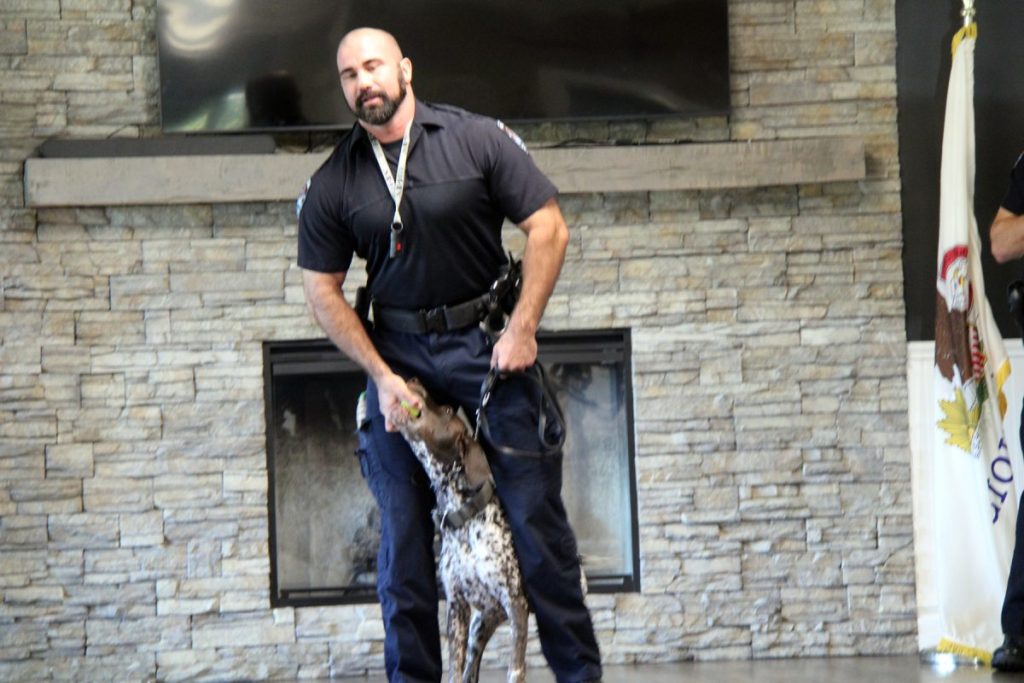
Troy Police Officer Cody Lucas and his K9, Szoldi, as Lucas tries to retrieve a tennis ball from the eager pooch. (Charles Bolinger photo)
Next up was Troy Police Officer Cody Lucas and his dog, Szoldi, a German short-haired pointer, who couldn’t wait to go to work. These dogs’ senses of smell are 100 to 1,000 more powerful than a typical human’s sense of smell, Lucas said. Using olfactory discrimination, he has been trained to separate the various odors his nose detects so he knows which ones to focus on.
Using soup as an example, Lucas said Szoldi can smell the meat, carrots, potatoes, soup stock and other seasonings separately. When they walk into a room, these dogs can differentiate the room smells, from any human’s body odor, any food present and the narcotics for which they are trained to search.
Szoldi and Enzo were trained in Shallow Creek, Pennsylvania, but born in Hungary, though the dog responds to commands in English. The dogs even have passports. They are also single-minded; they are focused on the work, not on sitting pretty, not on behaving, not walking properly.
On the floor were behavior selection devices, Lucas said, meaning the four wooden boxes. Each one contained a tennis ball but one was full of the dog’s food, a second one was lined with the dog’s favorite toys, another contained dog treats while still another was lined with cocaine and methamphetamine.
The dogs and training cost $15,000 but Lucas said the dogs pay for themselves quickly.
“He was associated with [a bust] recently. It was a semi-truck and trailer that had 10 kilos of cocaine, $75,000 cash and the semi truck itself, goes into asset forfeiture. With one stop, he paid for himself.”
He added that using Troy-based police dogs in collaboration with other area police entities nets the city 7% of any money recovered.
Lucas said that dogs that have been trained to sniff out marijuana are used less and less in Illinois, since marijuana has become more mainstream. Lucas said once a dog has imprinted on a certain aroma or odor, they can’t be taught to not smell it, so dogs who were trained on marijuana may end up with pets with the officers’ families if they cannot adapt to being therapy animals or doing other police work.
He said the dogs are trained not to bite, so they can be used to move through crowds with ease.
Like with Hank, the dog’s reward was a tennis ball. Both officers answered questions from the people assembled at the center.
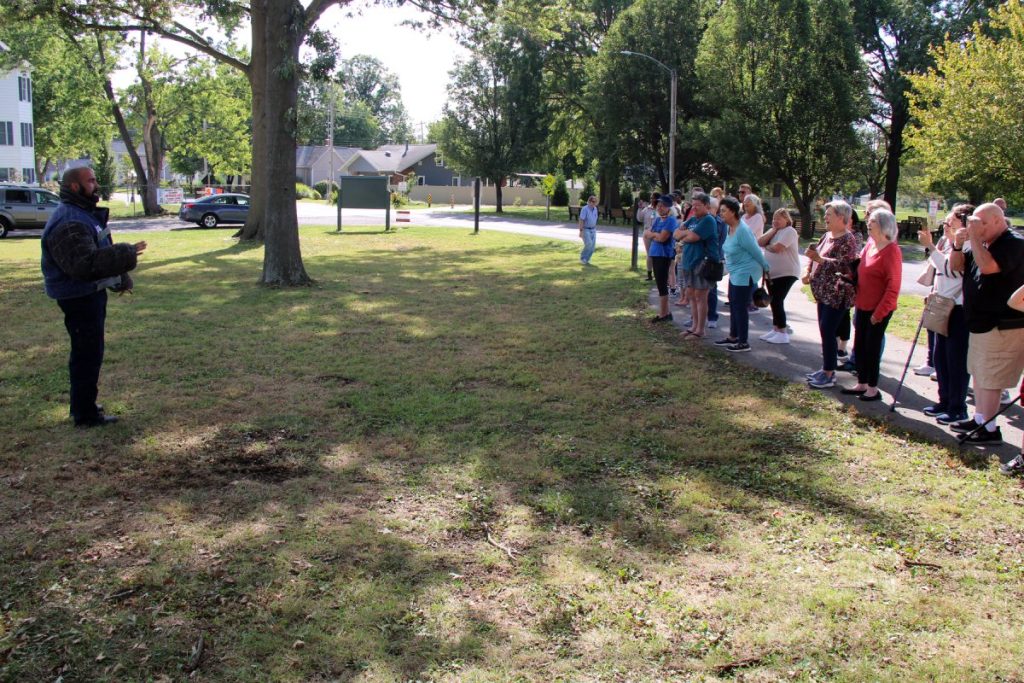
Officer Lucas, left, donned the “bite jacket,” an oversized, well-padded garment that shields his body from some of the damage done during takedowns. At least 50 people watched from the sidewalk. (Charles Bolinger photo)
Dogs who retire from the service are either adopted by the handler who owns the dog. On the flip side, Szoldi and Enzo are like bulls in a china shop, Christ said. They are bundles of energy that can cause minor accidents at the station.
Testosterone is not mandatory to be a police dog; Christ said there are plenty of female police dogs in departments that are just as ferocious and mean as their male counterparts.
The officers have to log at least 16 hours of certified DEA training plus they have to certify annually through Illinois, they said.
Then, the group headed outside and across the street for a more active demonstration from the apprehension dogs. Ringo and his handler, Madison County Sheriff’s Deputy Michael Barrett, faced Lucas, wearing what they term a “bite suit,” an oversized coat with lots of padding. Lucas also portrayed a perpetrator for Ringo and Zorro, a European German Shepherd, who belongs to Marissa Police Chief Laura Ottens. Both dogs attacked him and subdued Lucas with ease, despite weighing 250 pounds. Zorro knows commands in Slovak and Czech; he only knows one English phrase, “I love you,” because Ottens taught that to him, she said.
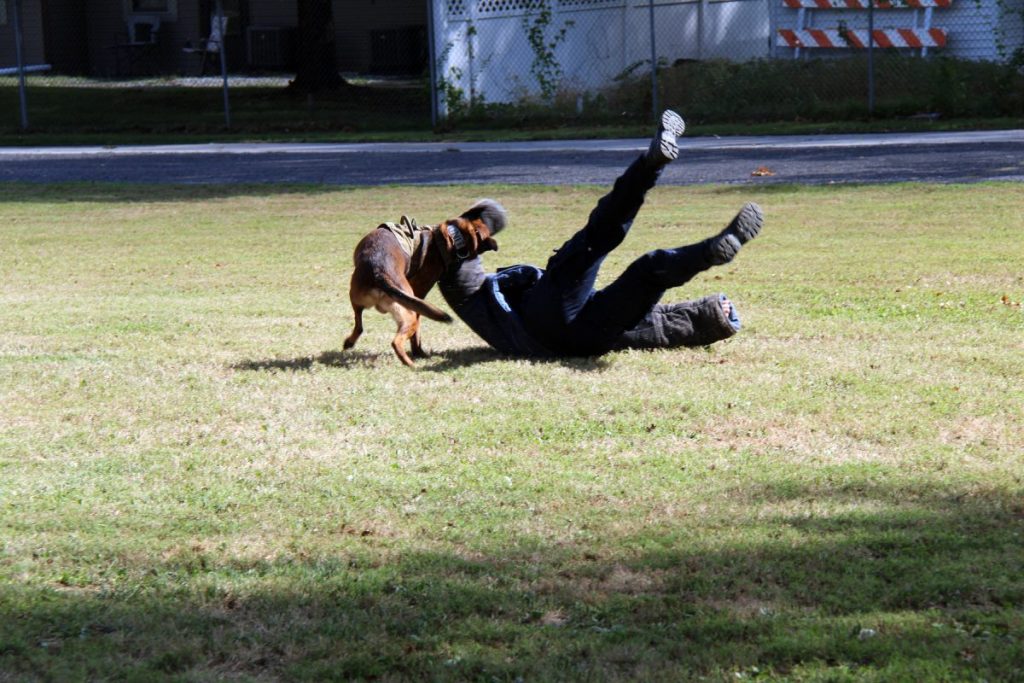
Here, either Ringo or Zorro subdues Officer Lucas in a field at Tri-Township Park. (Charles Bolinger photo)
The crowd from inside the center stood along the sidewalk in amazement as they photographed and videotaped the dog demos before heading inside for donuts and refreshments.
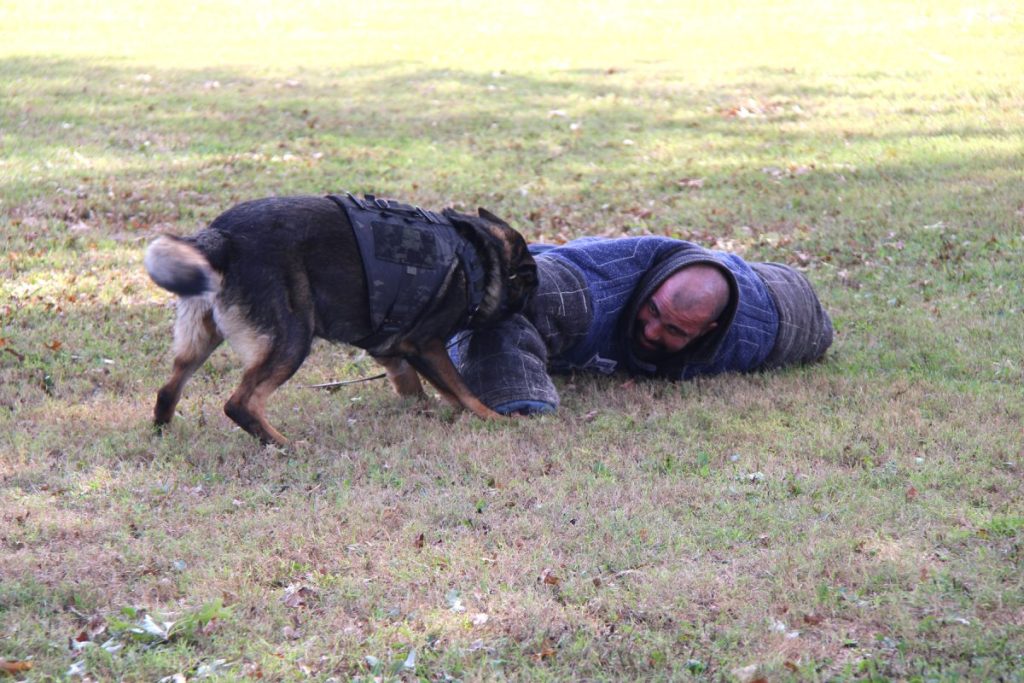
Lucas’ bite jacket is more visible in this shot, as again, the dog gets his man in the end. (Charles Bolinger photo)