Troy City Council denies data center concept site by Bethel Church
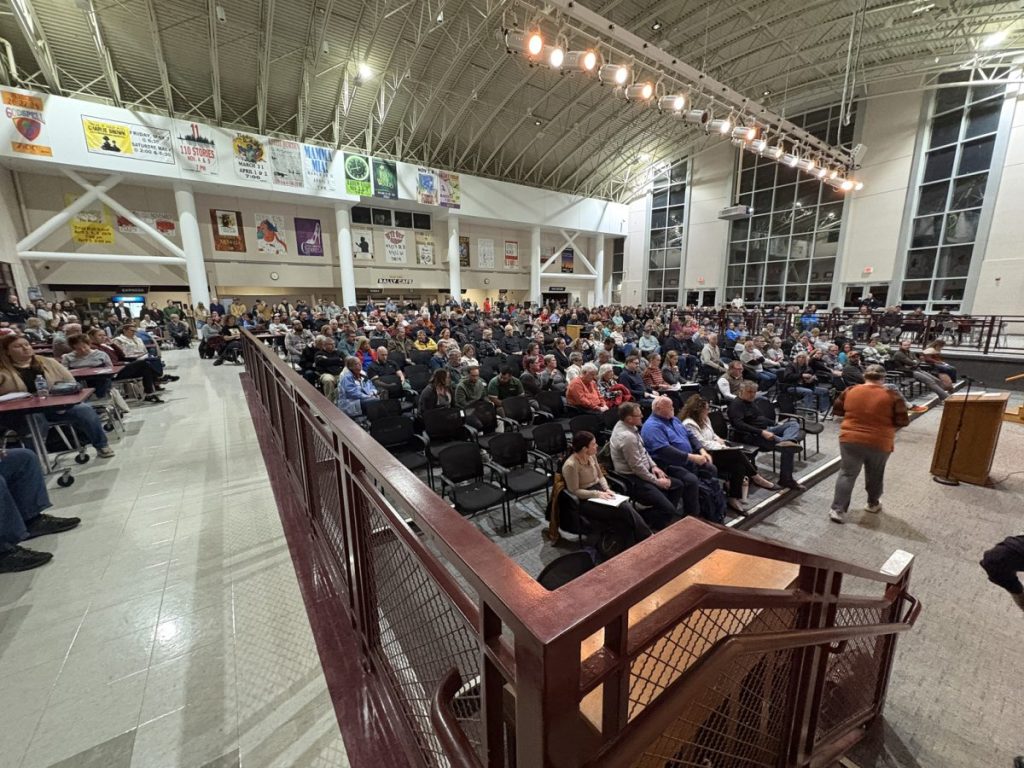
Troy residents and others turned out in droves for the Feb. 2 city council meeting at Triad High School to express further opinions on a possible data processing center coming to Troy. (Charles Bolinger photo)
By Charles Bolinger
Editor • Despite a new name and a Houston PR firm, the data center concept site revealed at a Jan. 8 planning commission meeting has been nullified.
Now called Project Beacon and backed by Innovant Public Relations, the data center concept must find a new home, either at another site near Troy or elsewhere.
“We have taken that [site] off the table,” said Mayor David Nonn on Feb. 2 of the concept first shown on Jan. 8 that would have put a data center between Collinsville Road and Route 162 and would almost completely surround Bethel Church. “We’re not going to allow our parks, pre-schools and our churches to be surrounded by these kinds of entities. That is not going to happen in Troy.”
Data centers are facilities that house computer servers and networking equipment to power the Internet, cloud computing and global operations. They support social media’s rapid growth and evolution, along with e-commerce (Amazon, Wayfair, etc.) working from home and artificial intelligence (AI), among many other things. Troy is located along a large fiber route, city officials said in November 2025.
During a city council meeting on Feb. 2 at Triad High School, Nonn took time during his portion of the agenda to give a wide-ranging, 31-minute speech about how the data center plan started and what happened with it since the Jan. 8 meeting.
Public participation, which usually occurs near the top of the meeting agenda, was moved to the end of the meeting, with the council’s agreement. Councilman Sam Italiano was absent.
“Approximately a year ago, Cloverleaf [Infrastructure] approached the city with a possible multi-million development,” he began. “Anything of this size obviously had our attention. We really didn’t know much about data centers and quickly educated ourselves [on that topic].
“Our first concern is the safety of the community,” he said. “We read up on things – saw what was going on in other communities, saw what was going on in Missouri and there are obviously huge safety concerns.”
He said they did a lot of homework on the topic. They contacted other communities to gather information about these data centers and Nonn directed City Administrator Jay Keeven to visit Papillion, Nebraska, an Omaha suburb that houses 12 data centers and to talk to Papillion officials as well as those running the centers. They asked others with data center experience what they liked about the process and what would they do differently about it if they could.
Nonn said a topic that kept surfacing was the amount of tax revenue that these things potentially generate.
“Our city’s equalized assessed valuation (EAV) is about $400,000,000; this is a billion or multi-billion-dollar project,” he noted.
He said the more we use technology, our phones, our computers, the more we use applications, AI and do things online, such as banking, grocery and pharmacy deliveries, medical records, the more we need data processing centers like this.
“The Triad School District just borrowed $100 million [in April 2025] to improve our schools. I’m all for it. We have the best school system in the area.
“Coming up soon, the city is going to need a new sewer plant,” Nonn said. “With the state’s regulations on phosphorus and [per- and polyfluoroalkyl substances] (PFAS), our sewer plant is old and outdated. We need a new one.”
He said the first sewer plant bid returned was for $50 million, which was rejected. Nonn and city officials re-bid the project and they await the new bids later this month, he said. The city’s water plant shows no detectable PFAS levels at this time, he said but he noted that Collinsville, which draws from the same aquifer as Troy, does have detectable PFAS levels. Nonn added he would like to soften the city’s water as many residents have complained to him about the water’s hardness. He agrees he said but reminds people that adding a softening process will cost money.
He said the commonality with PFAS and data processing centers are that Troy is working to stay ahead of the curve on both subjects.
“Everyone wants lower property taxes,” he said. “Everyone in this room would like to see that, I would assume. We would like to see that. The question is, can we do that in a healthy way? Yet to be seen.
Combined the city’s ($400M) and Triad Schools’ ($800M) EAV is $1.2 billion, he said. “When you start talking about an additional $1 billion to $2 billion or possibly more, that spreads the tax [burden] among industry and citizens. Nonn correctly noted that Troy has no sizable industry. “That is a very, very good reason to consider a project of this scale,” he said.
He said energy costs are poised to skyrocket regardless of where this data center ends up–in Troy, Maryville, Pontoon Beach or Glen Carbon.
He said he is all for green energy initiatives but he criticized the Climate and Equitable Jobs Act or (CEJA) for its role in raising energy prices, calling its implementation in Illinois “horrendous.”
He said the council and city staff are diligently searching for the answers they don’t have regarding data centers. The first priority is to protect the citizens, their children, the infrastructure and the parks.
“Everyone wants to live in Troy,” he said. “A house goes up for sale and ‘boom’ it’s sold. Rentals [go on the market] and ‘boom’ sold. Everybody wants the schools, the parks and the security the police department provides.”
He had multiple copies of the data center ordinance, 2025-46, that the city council passed last November, made and put on the lectern where residents signed up to speak at the end of the forum. He encouraged people to come up and grab a copy or to go online and print one from the city’s website and he coaxed them to read it. He also asked for more regular citizen involvement versus sitting at home, marinating in social media.
Nonn made it clear that he dislikes social media in general and Facebook in particular during his commentary. At one point, he referred to the social media titan as “Facebutt.”
“Get the information from the horse’s mouth; this is the horse’s mouth,” he said, indicating himself. However, his tirade against social media didn’t sit well with at least one audience member.
“We don’t need a lecture,” a woman fired back to a round of applause from the audience.
“If you talk again, you’re leaving,” Nonn warned her.
He said the zoning codes they drafted regarding data centers were their way of getting ahead of the issue so if a data center came calling, there would be hard rules in place, telling them what is allowed and what is not in Troy when it comes to data processing centers.
This way, he said Troy avoided a “Wild, Wild West” scenario where a company could sweep in, act unilaterally, take resources with impunity and have no regard for the citizens, the community or the environment.
Nonn said the ordinance set strict standards on lighting, noise, setbacks and water usage. He said the city’s daily water capacity is four million gallons; daily usage ranges between 1.2 million and 1.5 million gallons per day. Cloverleaf claims a closed-loop system would use one million gallons, or the equivalent of four Olympic-sized swimming pools. Nonn said a closed-loop water system is the only kind that meets the zoning laid out for these centers
Nonn said beyond the zoning codes, another thing was key to controlling what a data processing center can and cannot do – a special-use permit.
“We would be able to dictate exactly what comes out of that place, if one ever comes in,” he said. “We’d be able to tell you where the fences go. We’d be able to tell you where the berms go. Special-use is the way to handle this situation.”
Nonn re-iterated Troy’s legislative process, noting that plans like a data center must go through the city’s planning commission first. He said they do their due diligence on any topic before recommending for or against a project. The commission, however, is a non-binding one, meaning the city council need not agree with the commission’s decision before the council votes.
He brought this up because a rumor arose that city officials were “trying to slide something in the back door—not happening,” Nonn confirmed. “We’re transparent in everything we do.” He said the city must and does follow the laws. Again, he beseeched the audience to get more involved with the city. He also encouraged residents to call or write to their council members on this, or any other city issue.
Originally, Cloverleaf asked for a location between Collinsville Road and Route 162, Nonn said. That is the location that was revealed on Jan. 8.
“At our initial meeting, we said, ‘Hell no.’ This is not a good fit. This is not what we want in our long-term plan; this is not what we want people coming into Troy (via US 40 or passing by on Interstate 55-70) to see. We want much softer development there. It’s the face of Troy when you roll into town.”
After city officials rejected that original concept, Cloverleaf resumed looking at other candidate properties, Nonn said. They focused their attention further south, on the other side of US 40.
“This is behind (south of) RP Lumber and behind (south of) Commercial Drive, between Spring Valley and Formosa roads,” Nonn noted for reference.
There were contracts written with landowners and substantial offers were made, Nonn said, citing one landowner as asking for $200,000+ per acre. Two possible drawbacks to this area are at least two major pipelines, one for natural gas and the Buckeye Partners, LP diesel and gasoline pipeline, traverse this area.
“After several months of them considering that property, they came back to us and said, ‘We want to reconsider the 162-40 property.’ We were not in favor of that. I still don’t think that’s a good place if it’s gonna happen,” Nonn said.
Cloverleaf suggested they run it up the flagpole at the Jan. 20 meeting to gauge public opinion.
“I don’t know how many of you were at our last meeting but we ran it up the flagpole and the flag came back [down] with holes and burns,” Nonn said.
Nonn said Cloverleaf is again looking at the land south of US 40 between Spring Valley and Formosa for the data processing center. However, he said the same hurdles remain with that area; the aforementioned pipelines and an owner who resists selling his land.
After the Jan. 20 city council meeting, Nonn said he spoke to the aldermen. He said he doesn’t like to “lead” the council in one way or another as they are all capable of making their own decisions.
“After the meeting, when I talked to everyone, there was not one person who was in support of this going on that property. We still have things to discuss but it was fulfilling for me to see everyone up here felt the same way I did,” Nonn said. He added that Bethel Pastor Tim Lewis’ comments played a role in the decision to remove that land from consideration for a data processing center.
Nonn indicated he would give Cloverleaf a 30-day deadline to provide its latest information.
“We have some very specific demands—if we can cut property taxes, protect the environment, protect our people, pay for our schools, pay for our water plant, pay for our sewer plant and do it in a responsible way, we’re going to consider it. That’s the phase we’re in right now.”
The first data center forum is Feb. 10 at 6 p.m. at Triad High School, 703 East US 40, in the cafetorium. Following that is a public hearing on Feb. 12 for single-family villas along Troy-O’Fallon Road at 6 p.m. with the regular planning commission meeting to follow and the next regular city council meeting is Feb. 17 at 6:30 p.m.