
Public packs Triad High School to oppose data processing center in Troy
Cloverleaf has until March 2 to submit a new proposal
By Charles Bolinger
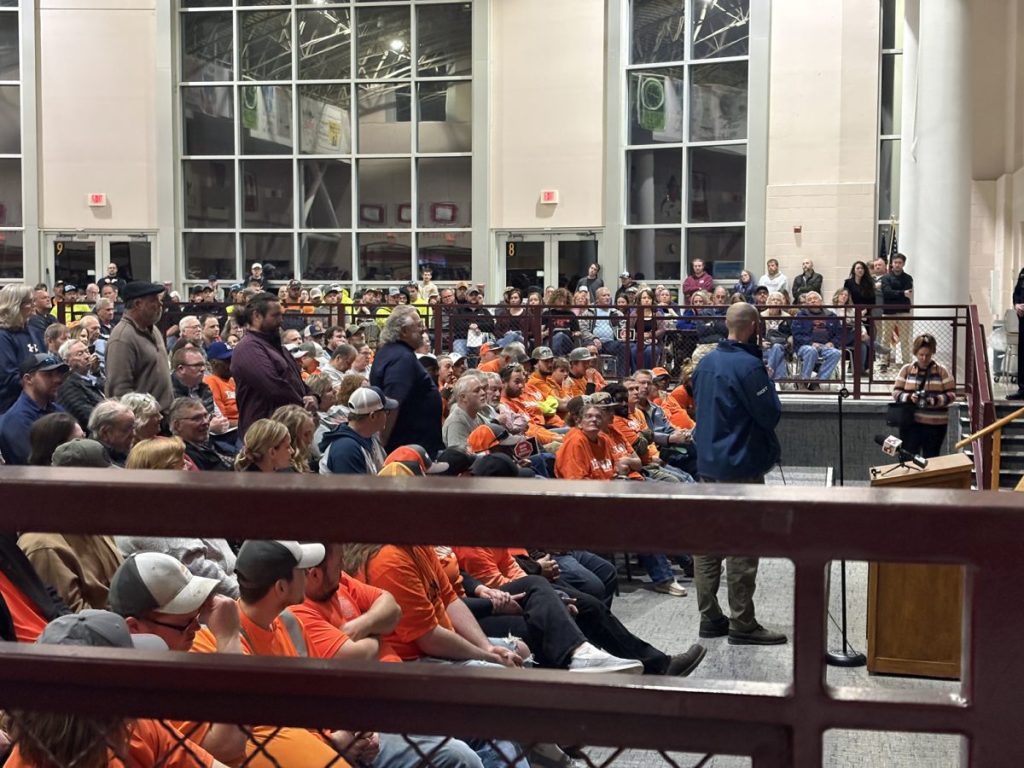
Editor • At least 500 people crammed into the Triad High School Cafetorium on Feb. 10 most of whom were there to oppose any kind of data processing center coming to Troy.
Even though the original concept for a data processing center was taken “off the table” by Troy officials on Feb. 2, anger, skepticism and frustration linger among residents and others who live nearby.
Now dubbed Project Beacon by Cloverleaf Infrastructure and Innovant PR, a Houston, Texas public relations firm, they handled the evening’s agenda and format.
Who attended, who was absent
On the left side of the stage were the usual Troy participants—Mayor David Nonn, City Administrator Jay Keeven, City Engineer Tom Cissell and Public Works Director Rob Hancock. Madison County Chairman Chris Slusser joined them.
Keeven told a reporter on Feb. 12 that the clock is already running on Cloverleaf to submit another proposal to the planning commission for review. The company has until March 2 to do so, meaning its 30 days started on Feb. 2, when the city council had its first meeting of the month at Triad High.
On the other side of the stage sat Erin Szalkowski, president of Innovant PR; Jeff Lake, development principal with Cloverleaf; Louis Linden, an energy manager with Cloverleaf; and David Streicker, an attorney representing Cloverleaf.
Neither Ameren Illinois nor Southwestern Electric sent representatives to this meeting. Southwestern’s CEO, Bobby Williams, attended a planning commission meeting at city hall last month.
In the audience, multiple trade unions attended, easily identified by their brightly colored T-shirts. They showed their silent support of the project as they would help build the facility, if one is approved.
Cloverleaf wavered between two sites
As Mayor Nonn said on Feb. 2, Cloverleaf officials have vacillated between two prospective sites in Troy. First, they started looking south of US 40 at land between Formosa and Spring Valley roads. However, they discovered that underground natural gas and oil pipelines pass through the area.
Next, they identified land north of 40 and east of I-55/70, which were the concepts they showed in early January that almost surrounded the Bethel Church.
After Cloverleaf officials watched a recording of the Jan. 20 city council meeting and heard of the city’s opposition to using that land, they backed off and switched back to looking south. Nonn added that besides the two pipelines as obstacles, there was a reluctant seller in the mix. No new data center concept was presented at the Feb. 10 meeting, as Lake said Cloverleaf wants to use forums like this one to listen to the public’s concerns and educate them about data centers before moving ahead with another prospective site.
Q&A with audience
Members of the audience lined up while Szalkowski intermittently read questions from comment cards and emailed questions that had been turned in prior to the meeting.
Audience members wasted no time needling Slusser about why a data center was planned for Troy and not going to Wood River, near his home. The first few speakers said they represented the Fawn Meadows subdivision, with its large, two-acre lots on the south edge of town, off of Spring Valley Road and they don’t want to be neighbors of a data center (if Cloverleaf chose to build south of US 40).
“I didn’t choose where these developers come,” Slusser started to explain only to be cut off by someone shouting, “Liar!” through cupped hands. “They did not come to Wood River; Wood River would love to have a data center,” he said, followed by a majority of the audience roaring for him to move this one to Wood River.
Lake said how Cloverleaf chooses a location is not based on picking favorites, it’s all based on power. Cloverleaf looks at substation capacities, transmission grid capacities, etc.
The second speaker asked Lake to name three places in the US where there are data centers that have not caused the surrounding residential property values to drop. He gave her comparables in Boydton, Virginia, where Microsoft has 36 buildings and Dekalb, Illinois, where Meta has six buildings on the south side of town.
Cloverleaf talking points
Earlier in the forum, Lake started by explaining what Cloverleaf is and what it does and how they work with hyperscalers (titan data center clients) such as Meta, Google, Microsoft, Amazon, Open AI and others. He re-iterated that they believe in transparency; they will not use non-disclosure agreements (NDAs) in this process. He referred to this meeting as Step Two in the data center process.
He spoke about the three hot sub-topics surrounding data centers – water usage, noise and power usage. He also tried to shoot down some Internet and social media rumors in the process.
He reminded everyone that according to Troy’s special-use permit, the only type of cooling system permitted is a closed-loop one. That means there will be no separate wells drilled and no chemicals injected into the ground; they would use the municipal water supply and not tap into the American Bottoms Aquifer independently.
He re-iterated that the system would require one million gallons of water mixed with glycol and would work much like a home’s air-conditioning system. A million gallons equates to four, Olympic-sized swimming pools. Over time, the system would need occasional top-ups to replace water lost to evaporation and being flushed out through the sewer system. No one seems to know what the correct top-up up interval is and ultimately, Cloverleaf officials said, that detail would fall to the end-user.
Next, he spoke about power and energy. He reminded everyone that the end-user, whoever it would be, will foot the bill for all electric infrastructure upgrades necessary – substations, transmission towers, transmission lines, transformers, etc. This is a 500-megawatt (MW) facility; there are larger and smaller data processing centers. Five hundred MW is enough to power 300,000 to 350,000 homes, he noted. Lake would later say that if the prospective end-user wanted to add more power, e.g. become a 1-gigawatt (GW) facility, it would have to start all over with the city for such approval to alter the special-use permit.
Nearby power supplies are what drew Cloverleaf officials to consider the original site in Troy, near Bethel Church. Power is another reason data centers are not just another version of a warehouse that can be put in a logistics park or warehouse district without an electric substation nearby.
There’s the Jarvis Substation on Formosa that was a factor in choosing the former site north of US 40, Lake said. The Collinsville Substation is north of I-55/70, about a mile west from the former site, which might have also been appealing. Further southeast, off of Liberty Road is a much larger substation that might work well for a site south of US 40, if it’s been upgraded to carry the correct power levels needed.
As far as data center noise, Troy officials set rules about noise and setbacks. Setbacks here are a 100-foot minimum from the public right-of-way; minimum building side to rear, 50 feet; and 200 feet from any residential buildings. Maximum heights are consistent with the city’s industrial zoning code.
Decibel (dB) limits were set at 70dB in non-residential areas, 60dB in residential areas by day and 55dB at night. No buildings taller than 50 feet will be permitted unless the company agrees to provide additional setback length.
Cloverleaf deferred measures like screening buffers such as trees, shrubs or hedges to city officials and to the end-user, saying those things may be included in the city’s special-use permit or are up to the end-user. Cloverleaf staff did not cite the specific threshold dB numbers for the audience, which led to skeptical laughter that Cloverleaf officials even know what the thresholds are for their own project.
One man asked the audience ‘who wants to hear a leaf blower-like sound at all hours?’ because he believes a data center will emit that kind of noise. Other questioners wanted to know where the backup diesel generators will be located and how close to their homes.
Lake said that is a site-specific question and difficult to answer, though he admitted the generators are one of the noisiest things about a data center. Keeven said he asked Papillion, Nebraska officials how they handle diesel engine testing and he told the audience that they are allowed to run each generator for 15 minutes per month. They then test eight generators at a time, only Monday through Friday between 8 a.m. and 4 p.m. Keeven said Troy will put similar conditions into the special-use permit.
Other Fawn Meadows residents claim the area is flat and they have water issues now from the nearby Mill Creek that rises in the farm fields to the north and runs through the neighborhood.
Other audience members remained skeptical about how, after the data center would be built, then who would then pay for all the power coming?
“As far as the infrastructure and the power consumption, that is all paid for specifically by the data center,” Lake said. “They’ll have a special rate structure that they’ve created that will account for those upfront costs, whether they’re paid for through the infrastructure up front or if that’s put into the rates.” He said it’s not the same rates as residents pay.
A man asked what happens after Cloverleaf leaves the community, will the end-user have to abide by the special-use agreement? The answer, city officials, said is yes, but they could not say at this stage what the punishment would be or how it would be enforced.
Lake said data centers, like most technologies, keep evolving. He said silicon chips used in them have a five-year lifespan. New chips will be brought after that initial chips wear out. As the chips become more efficient so that fewer racks of servers are needed. He said he knows of no place where a data center has been decommissioned or demolished. He also said he knows of no data center that has had its closed-loop system flushed and refilled. To be clear, not every data center uses this type of cooling system.
Lake admitted that while Cloverleaf formed relatively recently, during the summer of 2024, they have leaders who have previous experience.
“Our chief development officer was the global data center development manager for Microsoft for eight years and for Meta for two years,” Lake said. “One of the founders of our company was employee number one at Microsoft for energy. Our understanding of this space is not new.”
Slusser’s property tax presentation
Slusser illustrated how a data center could impact property taxes in Madison County. He said what most state taxpayers are aware of – Illinois has one of the highest property tax rates in the nation. One reason is that the state uses a tax model where property taxes are heavily used to fund public schools.
He said there are two ways to reduce property taxes—property tax reform at the state level or to dramatically expand the tax base in a big way. He said while Indiana chose the first option, he said there’s currently no appetite for that kind of reform in Springfield, which leaves the second option. Indiana’s 2026 property tax reforms, driven by Senate Enrolled Act 1, will deliver more than $1.3 billion in tax relief to homeowners and aims to lower taxes for roughly two-thirds of residents.
He cited living in Wood River and living in the Roxana School District with the Phillips 66 oil refinery. They are currently the largest taxpayer in Madison County, paying more than $26 million a year in property taxes. This, Slusser said, allows Roxana to have the lowest property tax rate in the county.
He said the fair market value (FMV) of the proposed data center using conservative figures is $1.62 billion and the equalized assessed valuation (EAV) is always one-third of FMV, or $540 million. Using Troy’s tax rate of 6.986%, the total taxes paid would be $3.7 billion, eclipsing Phillips 66 by a large margin.
Then his presentation delved into specific residential examples. Starting with no data center, a home valued at $300,000 would have an EAV of $100,000. Using the general homestead exemption of $6,000, the taxable value would be $94,000 and the combined tax rate is 6.986% for a total tax of $6,566.84.
Comparing those numbers to what a data center could theoretically do if all of the other taxing districts kept rates the same, yielded the same FMV and EAV and the same taxable value as before, however, the combined tax rate would tumble to 4.2333% or a total tax of $3,979.30. That’s a 39.4% drop.
He then introduced an example with a data center plus 25% growth captured by the other taxing bodies. All of the numbers remained the same except for the combined tax rate, which in this example was 4.9215% and translated to a total tax of $4,626.21, or a 29.6% reduction.
Slusser then repeated the example with a home worth $500,000. With no data center, the EAV is $166,650, the taxable value is $160,650 and the combined tax rate is 6.9860% for a total tax of $11,223.01.
Adding a data center to the mix kept the FMV, EAV and taxable values the same but lowered the combined tax rate to 4.2333% for a total tax of $6,800.80, again a 39.4% decrease.
A data center plus 25% growth to the other taxing districts means a 4.9215% combined tax rate for a total tax of $7,906.39, or 29.6% percent less than without a data center.
Slusser said that he’s directed the county assessor’s office to start pulling Dekalb home sales and property values near its data center sites to use as comparables and once complete, they will be available upon residents’ requests.
More than one person in the audience believes that any reduction in property taxes for residents will be more than offset by rising energy costs due to a data center in Troy. However, Bobby Williams, Southwestern Electric’s CEO said last month that the requests for proposals (RFPs) he sent for energy deals through 2030 that came back with a 40% jump in wholesale energy prices, and that was without a data center in Troy. He added that Southwestern plans to raise its rates later this year for the first time since 2013, thanks in part to some bitcoin data centers that have sprouted within their zone.
The next regular city council meeting is Feb. 17 at 6:30 p.m. and it will likely be at one of Triad’s schools, the final site to be announced.
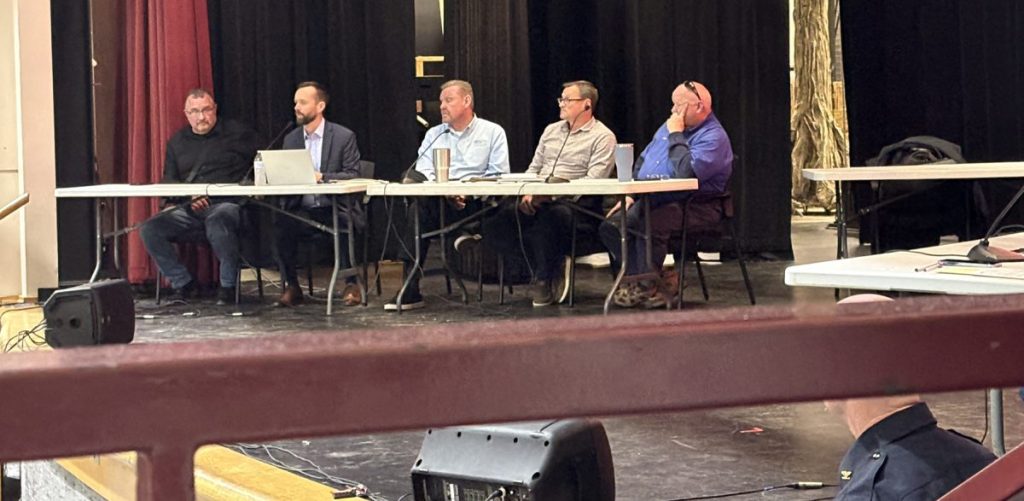
From left are: Troy Mayor David Nonn, Madison County Chairman Chris Slusser, Troy City Administrator Jay Keeven, Troy City Engineer Tom Cissell and Troy Public Works Director Rob Hancock. They comprised one of two tables at Triad High School on Feb. 10 for a data center forum hosted by Cloverleaf Infrastructure. (Charles Bolinger photo)


Will vibration and noise from the data center operation effect the “undermining” from the coal mining in the surrounding area, creating sinkholes and other problems in structure of homes and buildings?