Troy man’s ‘66 Plymouth Satellite receives thumbs up, honks of approval
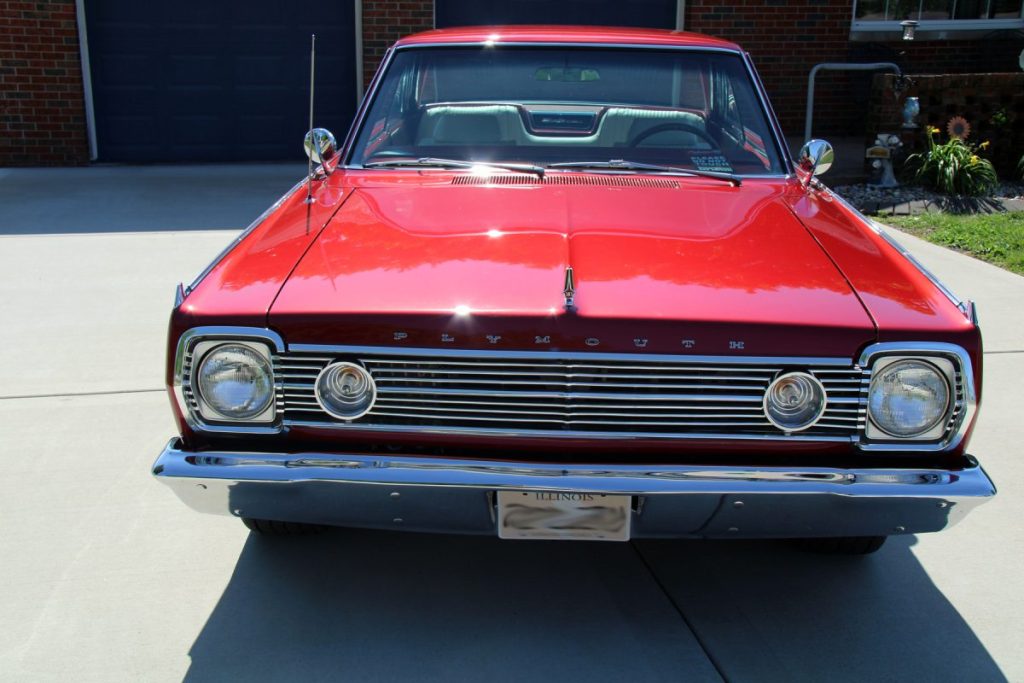
With its squared-off styling, this 1966 Plymouth Satellite is a stark contrast to today’s rounded vehicles. (Charles Bolinger photo)
By Charles Bolinger
Editor • Like many other auto manufacturers, Chrysler was not immune to trends. One of those fads was to name vehicles that echoed names found in the Space Race during the 1960s. Plymouth elected to call its new full-size car Satellite for 1965.
Troy resident Rick Muller owns this 1966 Plymouth Satellite that was originally assembled in Highland Park, Michigan at Chrysler’s Lynch Road factory. It was born on March 23, 1966 and left the assembly dressed in Citron Gold Metallic paint with a gold vinyl interior. There was also a 318 CID V-8 engine with a two-barrel carb under the hood. Sometime between 1966 and 2012, that all changed.
It left Lynch Road with the following options – a center console, rear armrests and ash tray, the Clean Air package, a 26-inch wide radiator, a two-watt Music Master AM radio, air-conditioning and heater. Now, that car is finished in a dark red with a black-and-white vinyl interior and is visually striking. The sharp, boxy styling adds to its appeal, especially compared to today’s jellybeans on wheels. Under the hood is a 383 CID Commando V-8 engine with a mild cam and a four-barrel carburetor and breathing through dual exhausts. It is backed by a TorqueFlite 727 three-speed automatic transmission with a stall converter, shift kit and a 3.23 rear end.
A quirk of the car is it that came equipped with air-conditioning and power steering but no power brakes.
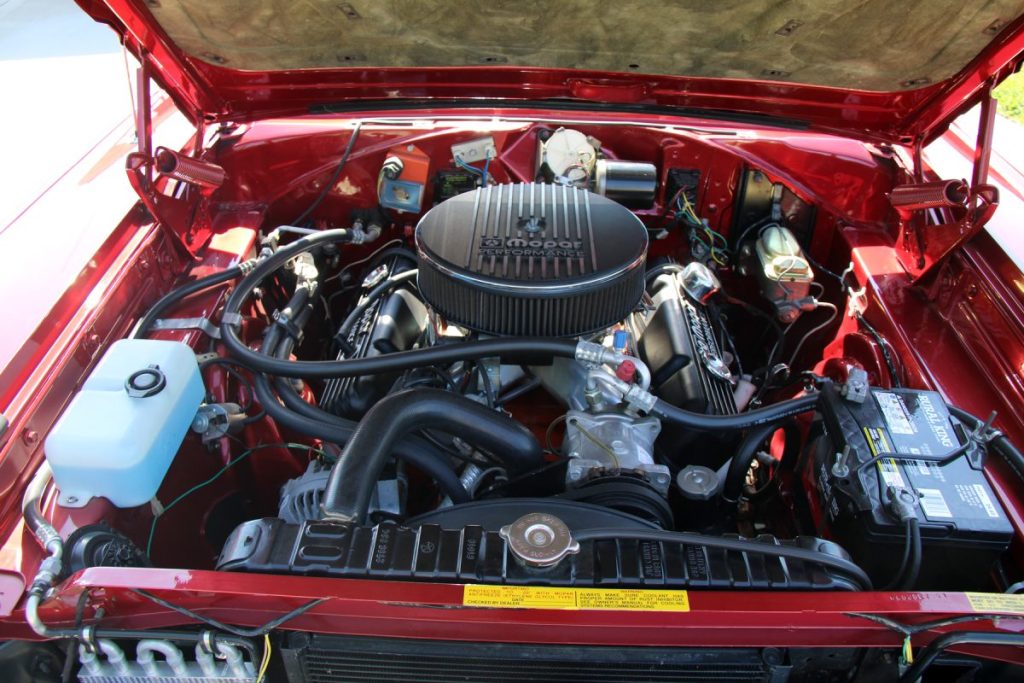
Chrysler’s 383 Commando V-8 engine lives under the hood, this one with a four-barrel carb. Note that there is an air-conditioner and a power steering pump but no vacuum booster for the brake master cylinder. (Charles Bolinger photo)
A reporter talked to Muller about the car on June 18. He does not believe the previous owner reset the car’s odometer before or after refinishing it, so he thinks it has less than 2,000 miles on the clock since the restoration. He thinks the restoration took about three years, working on it mostly nights and weekends.
“I had one of those Satellites when we first got married in ‘76,” he recalled. “It was a good driver; I always liked that bodystyle, the ‘66 and ‘67 Satellites and GTXs.” The GTX was billed as a “Gentlemen’s Muscle Car” and was among the many competitors in the muscle car field that followed on the Pontiac GTO’s coattails.
“I saw this car for the first time in 2014 at the Wild Country Car Show in Collinsville,” he remembered. “Their lot was so large, they would put you in the class in your row.” He said it was a former Western-themed venue during the line dancing craze. Wild Country closed in January 2019.
“It was a huge parking lot with a nice set-up. This particular car was in a class by itself, away from everything else. I think that’s what the previous owner wanted. The color, I just gravitated to it.”
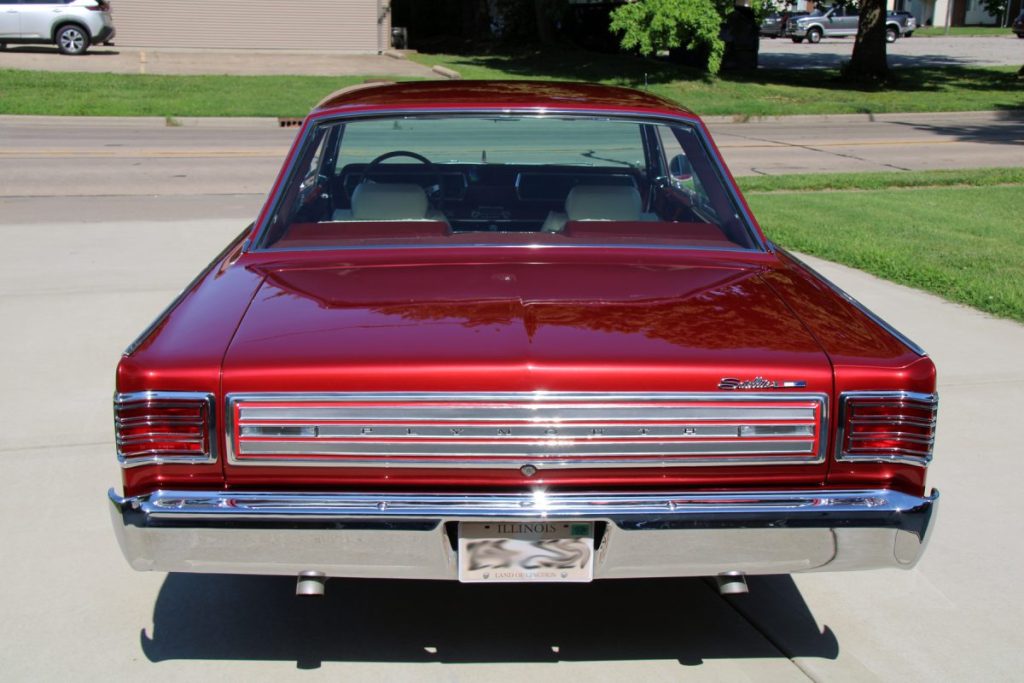
This is the view that most drivers are likely to see of Rick Muller’s 1966 Plymouth Satellite when he takes it out for a drive. (Charles Bolinger photo)
He said in 2014 the car was only two years past a complete restoration. “I never even thought that someday I’d own that car; I never did. We talked a little bit and I told him how much I loved his car. That was the last time I saw it until about a year-and-a-half ago when we were at the Dairy Queen Car Cruise here in Troy. We always got there early so we could eat.
“I didn’t even see the car pull in and he pulled in and parked away from everybody else. He had his grown son and his wife with him.
“My buddy went down and looked at it. He came back and said, ‘Rick, you should probably go look at that Satellite. He’s got a For Sale sign in the front seat.’
“I went over there and I talked to him. I asked if he’d mind starting and he said, ‘Oh no, not at all.’”
The owner started it and let it run for a bit before shutting it down. Rick asked if he could come to the man’s house the following day to drive the Satellite.
“He lives off of Spring Valley Road in a new subdivision,” Muller said. “He had it sitting there in the driveway. I took it for a short drive and came back.”
Muller said the man and his son had worked on it together even though they had hired a third party to help out.
“I want to ask you one thing, can you come back before 4 p.m?” the owner asked Rick. He didn’t want his son to witness the Satellite’s departure as it would have saddened him. Rick agreed to arrive earlier than 4 p.m.
Muller said the house off of Spring Valley Road was a downsizing move for the man; they used to have a large property on Mill Creek Road with lots of amenities, including a three-car garage.
“He didn’t have the space to keep it and he didn’t want to pay [to store it], so I ended up going over there the next day to pay for it and I brought it home.”
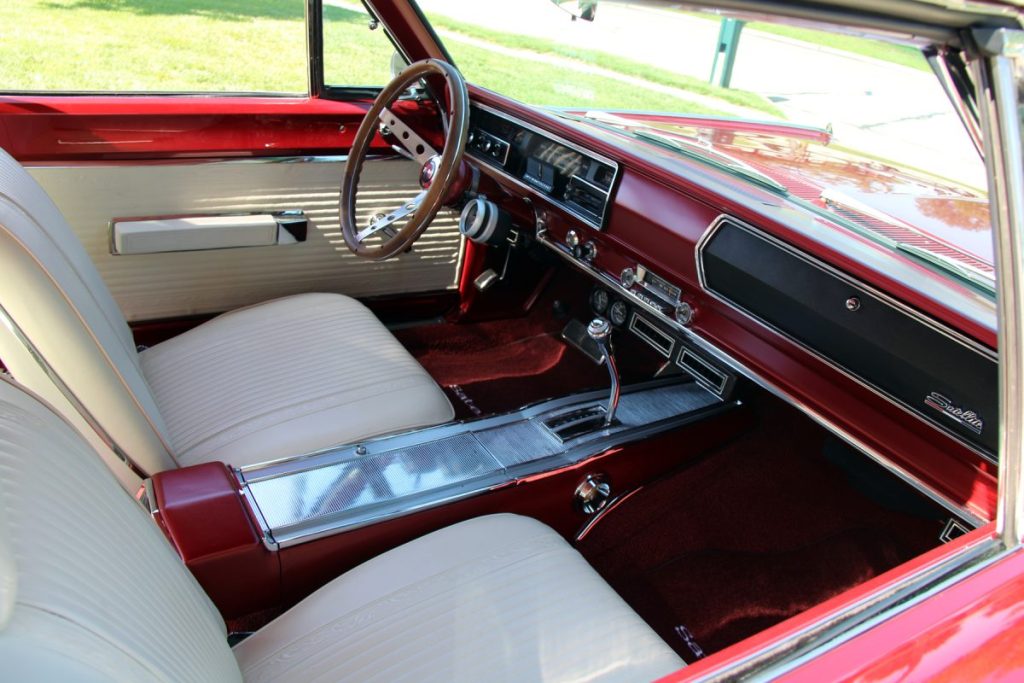
A glimpse inside the Satellite’s interior, which was textbook 60s-era Chrysler. There are a pair of courtesy lights in the center console, just below the gearshift and they still work. (Charles Bolinger photo)
That is when the former owner told Muller about the ‘73 Duster Muller now owns. It belonged to the former owner’s brother when he lived in Damiansville before moving to a home near Troy-O’Fallon Road.
He said the front bucket seats are not original to the car because they have headrests, which would not become standard until 1969. The seats are rare and hard-to-find, as is the trim panel between the taillights.
As Chrysler was the smallest of the so-called Big Three, parts are harder to locate compared to similar Ford and GM vehicles.
“This one draws a lot of attention, especially with MOPAR guys,” Muller said. “Most of the guys gravitate to it because of the paint – the quality and the color combination.”
Muller said he rotates his fleet of classic vehicles; this one gets out every 1.5 months to two months.
While a reporter interviewed Muller, a man walked down the sidewalk past his home. On his way back with a folded newspaper in hand, he told Muller, “Now, your house does look good.”
A few minutes later, another man in a pickup truck headed southbound on Riggin Road. He stuck his head out of the truck’s driver’s side window and called out “70?” to which Muller replied, “No, it’s a ‘66.” The man gave a thumbs-up in return and drove on.
It also took until then for Chrysler to recover from a gaffe that afflicted Dodge and Plymouth for the past four years. Sometime in late 1959, either at a corporate holiday party or on a golf course, Chrysler’s then-new boss, William Newberg, thought he overheard General Motors’ head, Ed Cole, talk about a smaller full-sized model that Chevrolet was getting ready to launch in 1962.
Trusting the source without verifying the information, Newberg promptly rushed Dodge and Plymouth into matching the rumor for 1962; Chrysler models were left alone due to time constraints. Remember that back then, new models emerged every autumn, so 1962s would come out in late 1961. That only gave Chrysler about 18 months to completely re-do Dodge and Plymouth models.
The new 1962 cars were a sales disaster, the biggest one since Ford’s Edsel in 1958. Sales dropped precipitously; they were 20% lower at Plymouth and 33% lower at Dodge than before. What did Cole talk about at that party or on the links? Chevrolet’s new compact car for 1962, the Chevy II, which later became the Nova. Newberg was fired in mid-1960.
Nineteen sixty-size models did not differ much from the ‘65s. For 1966 and 1967, the interior vinyl seats and door panels were treated to a unique ‘Western Scroll’ design which mimicked tooled leather in appearance. For 1966 and 1967, the Satellite was again offered only in two-door hardtop and convertible body styles and was powered by V-8 engines. Production figures for 1966 were 35,399 hardtops and 2,759 convertibles.
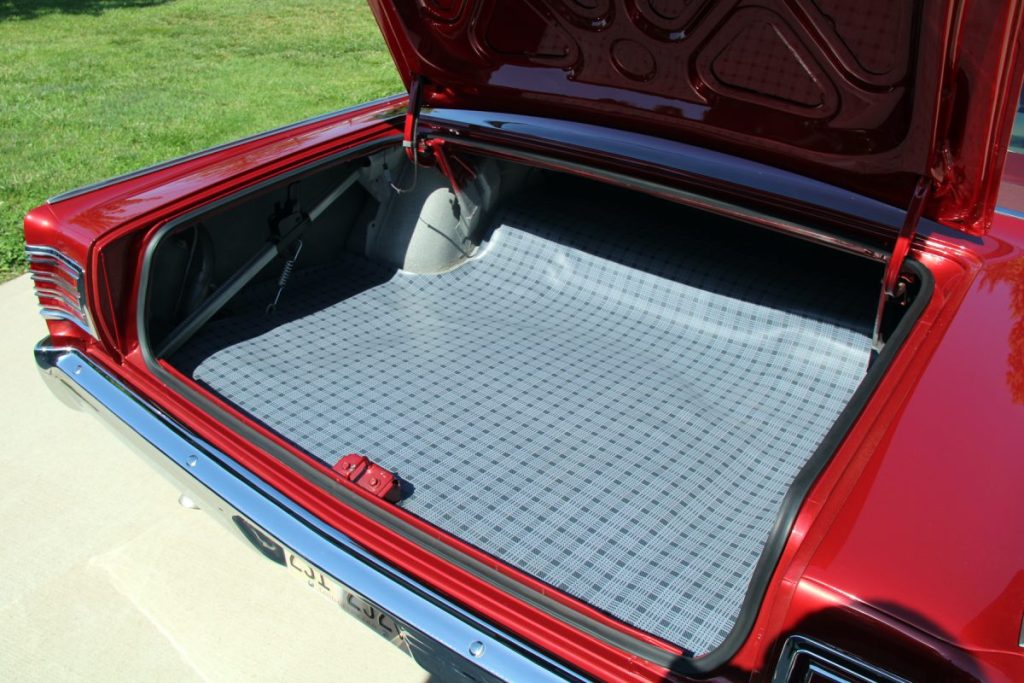
With one of the cleanest cargo spaces around, this Satellite’s trunk also has its own jack, back when the front and rear bumpers were common jack points on most light-duty vehicles. (Charles Bolinger photo)