Madison County, AT&T approve agreement over 911 circuits
By Randy Pierce • Installation by representatives of AT&T of 9-1-1 circuits related to the emergency response communication system in the wrong locations in Madison County has resulted in a reduction of about 50% in its bill for this service.
A resolution approved by the county board at its most recent meeting noted a one-time settlement payment totaling $522,461.23 will be paid to AT&T out of the Emergency Telephone System Board budget, this amount representing a significant reduction of the original contract price of $1,045,922.41.
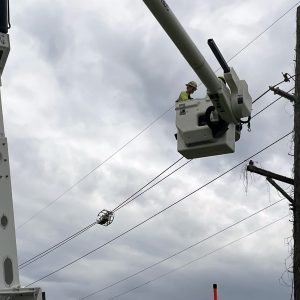
At issue concerning the settlement was AT&T’s handling of its OPT-E-MAN services, which offer advanced networking capabilities utilizing an optical ethernet, providing an integrated means of communication consisting of a fiber and/or copper transport component connected to a device capable of switching and routing, vital aspects of the county’s 9-1-1 program which has undergone extensive renovation, consolidation and upgrading in recent years.
The resolution establishing the settlement payment was brought forward to the county board by its ETSB committee, public safety committee and finance and government operations committee chaired by Dalton Gray of Troy.
At a meeting of the public safety committee, chaired by Terry Eaker of Bethalto, held in early June, Arron Weber, 9-1-1 emergency telephone coordinator, explained the circumstances leading to this settlement.
He began by sharing how in September of 2024, an invoice indicating the aforementioned $1 million-plus total from AT&T that had not been paid was found, having originated in 2022.
This related to the elimination of some 9-1-1 circuits being phased out by AT&T which were formerly, but no longer, funded by the Illinois State Police division related to emergency response call service.
Weber said that when he took over his current position, it was understood the county was going to be reimbursed by AT&T for those circuits but in order for that to happen, the bill which was found had to be paid.
Subsequent research by Weber, his staff and an assistant state’s attorney led to the decision to pay only half of the pending invoice because AT&T had installed the OPT-E-MAN circuits in places where they were not needed instead of where the county preferred they be located.
While all this was in a state of processing, orchestrated movement was occurring regarding the state mandate that Madison County consolidate its 9-1-1 public safety answering points by reducing the previously existing number of 16 at that time to seven.
As the county was preparing to complete that consolidation and with the support of David Livingstone from the state’s attorney’s office, Weber and his team went into a negotiation mode with AT&T.
“They initially pushed back pretty hard,” Weber told the public safety committee last month, “and only wanted to give us like a $35,000 credit and that wasn’t good enough, for me especially.”
Eventually the existing settlement agreement finally transpired with both sides finding it to be amicable, Weber explained, adding, “Like I said, there were some issues on both sides with AT&T delays.”
While the situation was what Weber described as “strained there for a bit,” the county now has “a great working relationship with AT&T” and things are back to where they should be.
Eaker reacted by saying, “I don’t think Arron dropped the ball on any of this at all. I think you just cleaned up a big mess and actually saved us some money.”
Weber elaborated that the county had been actually paying for two sets of circuits at the same time and questioned why this was occurring, the only actual documentation about any possible reimbursement being a single e-mail message which had been discovered that was written by a “guy that has since been let go from AT&T.”
Much of this scenario resulted from action that occurred on Jan. 1, 2016, when the Illinois General Assembly’s adopted legislation, going in effect then, amending its Emergency Telephone System Act, repealing provisions in existence at that time, for the purpose of consolidating local 9-1-1 units in preparation for a statewide conversion to a modernized “next generation” system.
Most significantly for municipalities and counties, the new act severely limited local control of the operation and maintenance of emergency telephone systems by rescinding the authority of those government units to collect telecommunications surcharges and instead replacing them with a statewide surcharge while also ordering the consolidation.
Madison County is not the only one required to follow this consolidation order which originated in 2016 and is statewide. The 16 PSAPs in Madison County were cut down to eight, a high priority topic for Weber and his staff since he took his current position formerly held by Dana Burris.
There is a surcharge designated for 9-1-1 support on everyone’s telephone service bill, showing up on it every six months, which is collected by the state that was initiated as a means of helping offset the costs of purchasing and installing the necessary new equipment with a share of those funds provided to each county.
Connected with the order to consolidate the PSAPs, the state is now keeping a much greater share of that surcharge income with the counties getting less. Another factor involved in this situation concerns how the previous 9-1-1 system had been determined to be obsolete, thus necessitating its replacement.