Glenwood Cemetery clean-up in Collinsville is July 11
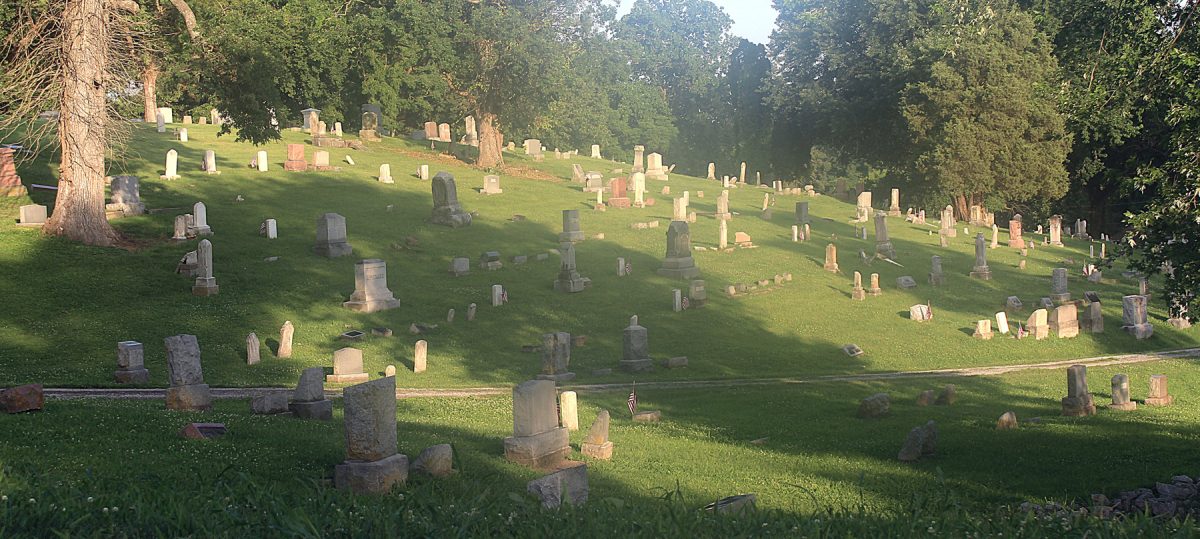
A shot of the Glenwood Cemetery and some of its headstones. (Randy Pierce photo)
By Randy Pierce • Clean-up work at Glenwood Cemetery in Collinsville has been scheduled for this Saturday, July 11, from 8 a.m. until noon. Anyone wishing to participate in this effort is encouraged to show up during those hours and bring a rake or shovel along with gloves to wear.
The cemetery is located at 108 West Church Street, west of Illinois Route 159, and is accessible from the south by way of Loop Street off 159 or from South Center Street downtown.
At a presentation held on Sunday, June 28, in the city hall council chambers, Bonnie Krupp, the cemetery superintendent, shared information concerning the history of Glenwood which was purchased by a local church for $100 from Elizabeth Collins in 1847.
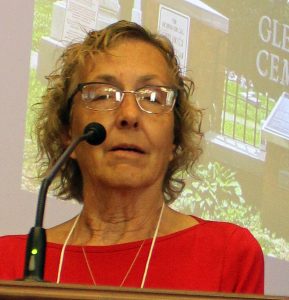
Bonnie Krupp, superintendent of Glenwood Cemetery, speaks to the cemetery’s history last month at Collinsville City Hall. (Randy Pierce photo)
The name Glenwood, where many of the city’s founding fathers are buried, Krupp explained, was used because of the abundance of trees on the property. The prominent early families represented in various graves include those named Collins, Griffith, Wadworth, Wolf and Blue.
Krupp’s devotion to the history of this site prompted her to tell those listening to her presentation that, “it’s very important that we preserve our heritage and not let it go to waste.”
She further noted that there are people who came to the United States from 18 different countries buried at Glenwood, referring to it as a “melting pot” and commenting, “I think that it is very interesting to have that many immigrants from across the world buried out here in a small town.”
Another characteristic of Glenwood Cemetery shared by Krupp concerns how, unlike other similar places which have lots designated for “paupers,” there is no distinction between the areas where rich and poor deceased people are, “They are buried next to each other.”
Also pointed out by Krupp is how many older cemeteries kept the northwest corner of their properties reserved for African-Americans but this is not the case at Glenwood, prompting her to emphasize, “You can find an Englishman buried next to an Italian or Lithuanian coal miner. You can find the rich buried next to the poor and you can find the prominent buried right next to the unknown.”
A man named Michael Squires was the first to be buried at Glenwood which started as a one-acre donation from a Mr. Collins, since having grown to 9.1 acres, six of which are mowed regularly and the rest which Krupp said, “We are trying to keep under control.”
Along with soldiers who fought in the Revolutionary War, Krupp said the cemetery includes those who were part of the War of 1812, Black Hawk War of 1832 (resulting from a land dispute between the U.S. government and a Native American tribe), Mexican-American War and 95 from the Civil War in the 1860s.
Glenwood Cemetery also contains veterans of the 20th Century’s two world wars plus the conflicts in Korea and Vietnam.
Along with a Civil War medal of honor recipient, there is another individual whose headstone describes this person as a “sapper” in the same conflict, that title used for an Army engineer who apparently trained at Fort Leonard Wood in Missouri.
The sappers, as explained by Krupp, did a lot of digging of ditches and building of bridges to assist with Army movement but also installed explosives underneath Confederate prisons to help free the Union soldiers confined in them.
Yet another Civil War casualty whose wife is in Glenwood Cemetery, according to Krupp, died from poisoning by eating food containing flour tainted by Confederate enemies. This young woman, as Krupp tells it, asked that the Union army send her husband home so she could nurse him back to health, but this request was refused and she went to Washington D.C. by train and convinced President Abraham Lincoln to allow her husband to be freed as she had asked. She was able to restore his health so he could return to participate in the remainder of the Civil War.
There are three freed slaves, Clara H. Lewis and James Henson Rhodes, who served at Wilkerson Chapel on Summit Avenue in Collinsville, and Spicy Mumford, buried at Glenwood.
Historical research of old newspaper clippings has led to the existence of “ghost” stories concerning this cemetery, Krupp said, including one where students at the nearby Webster School would see people walking among the graves on the property but suddenly disappear.
Another tale cites how crying and sobbing could be heard at night at the cemetery, this attributed to the wives of fallen Civil War soldiers, while there were other reports of a woman hitchhiking who would get into a vehicle then disappear, leaving a small puddle of water in the seat where she had been sitting.
The cemetery also contains victims of a tragic cholera epidemic that occurred in 1849 in Collinsville, when 40 deaths occurred in a period of 42 days, including children, some families having lost two or three of them to the disease.
Two years ago, according to Krupp, restoration efforts at Glenwood were initiated, this consisting of cleaning, uncovering markers, probing and resetting tombstones, some of which were six or eight inches below the surface and had to be carefully dug up so as not to cause any damage, along with trimming trees and grooming the grounds. Then in 2025, a service was contracted to remove dead trees from the easternmost three acres which are part of the property.
The selling of lots at Glenwood has been suspended, Krupp stated, until a determination has been made concerning exactly where all of those people buried there are located. While some of the headstones are made of limestone, marble or granite, there are a few consisting of terracotta, cast with very shiny surfaces, or zinc, two types of materials Krupp said she had never seen in a cemetery previously.
A curious matter regarding the zinc headstones as told by Krupp concerns how the names are on metal plates attached with screws. During the Prohibition Era in the 20th Century, when the sale of alcoholic beverages was not permitted by the federal government, people would remove those nameplates, hide the booze in the bottom of the marker then reattach the nameplate and communicate with others who would go to this location to get the unlawful liquid.
“We think this cemetery is vital to this community,” Krupp said, “and I’m hoping to get more interest raised so that other people find it as interesting and as important in history as we do.”
After Krupp’s presentation had concluded, those present to hear were invited to stroll a couple of blocks to the cemetery for a walking tour.