Even during the Great Economic Depression Chevrolet’s 1933 models sold well
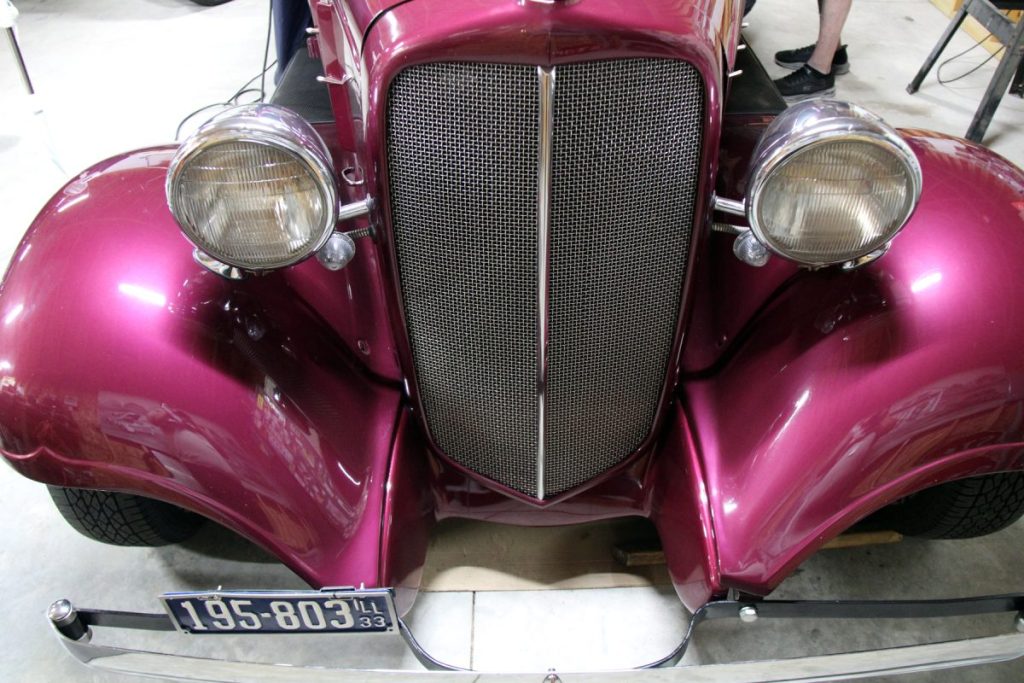
In this view of the car’s nose, one can see the original Illinois license plate from 1933 and note the difference in size compared to today’s plates. (Charles Bolinger photo)
By Charles Bolinger
Editor • Of his three classic vehicles, Ernie Huffman has owned the 1933 Chevrolet the longest.
“That one, I pretty much did myself,” he said. “It has a small block Chevrolet engine, automatic transmission and air-conditioning. I tried to keep it the old-school look with the mag wheels and everything the way it is. I didn’t go real elaborate on the customization.
“It is a ‘33 and as I said, the license plates are narrower and longer [than today’s plates]. In ‘32 and ‘33 they were more like the European ones.”
Huffman, who lives near Troy, said he tried to retain the car’s original appearance, opting not to do things like shave off the exterior door handles, or other tricks that today’s customizers covet.
All of his classics have license plates that correspond to their respective years of manufacture.
The 1933 Chevrolets were also among the final models to use wood during construction. The final year for partial wooden bodies was 1934; the next year, they were made entirely of steel.
The car was called “Eagle” early in the 1933 production year. When it was joined by the cheaper Chevrolet Standard Six (Series CC) later in February of 1933 the Eagle name was changed to “Master.” The Series CA sold a combined 450,435 vehicles, an increase of nearly 140,000 over the previous year’s Series BA sales of 313,395, and ensured that Chevrolet was able to retain their number one spot in American car sales.
There are several differences between the Eagle and Master. The easiest way to distinguish between the two is the post between the front door vent windows and the roll down windows. On the Eagle the chrome divider between these two windows goes down as the window goes down, whereas on the Master this divider remains fixed.
“The ‘33 Chevy does not have a radio,” he noted. That means you must listen to the car’s natural soundtrack when driving it – the engine, the transmission, the exhaust, etc.
“The ‘33, because of the configuration, there isn’t much room once you’re inside to drive it, so you’re kinda squished.”
The car’s vee-shaped engine bay made this especially apparent and that lack of space is why the ‘33 lacks some of the power assists found on the other two vehicles but overall, Huffman tried to make his classics comfortable by “restomodding” them, or adding modern features to vehicles never designed to have such options from the factory.
He bought the ‘33 Chevy in Union, Missouri.
Huffman is a member of the Lakers Car Club and he takes the classics out about every weekend. He’s been with the Lakers since 2010 or so.
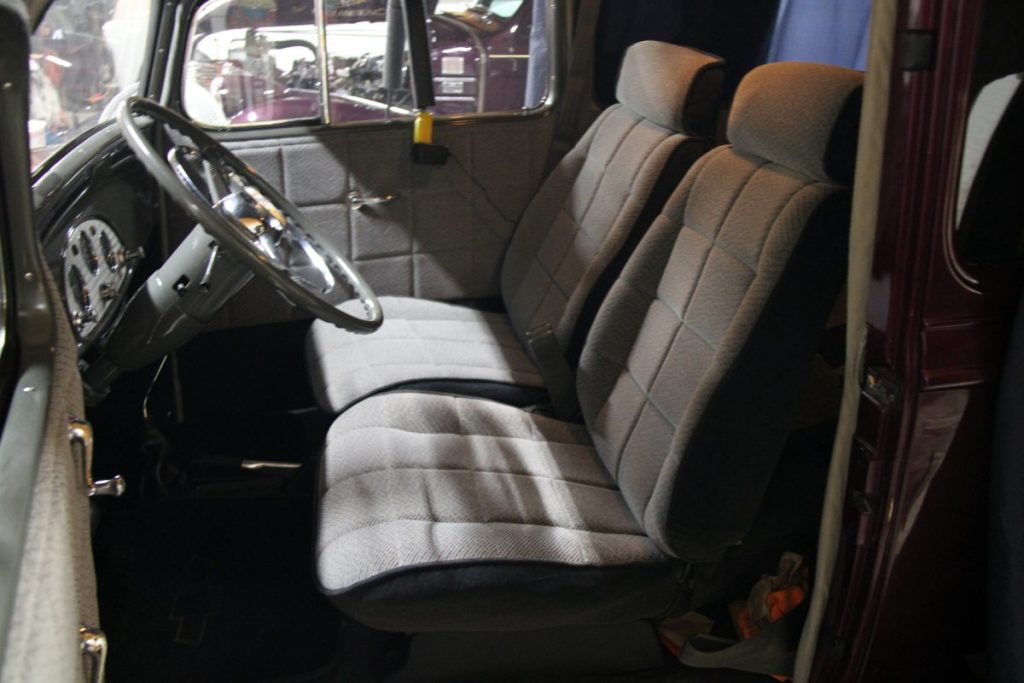
Inside, the car’s cockpit is a cozy place, owing to the styling and how much smaller (width) yet taller (height) than current cars. (Charles Bolinger photo)