Collinsville tables Haven Hill development to address residents’ concerns
By Charles Bolinger
Editor
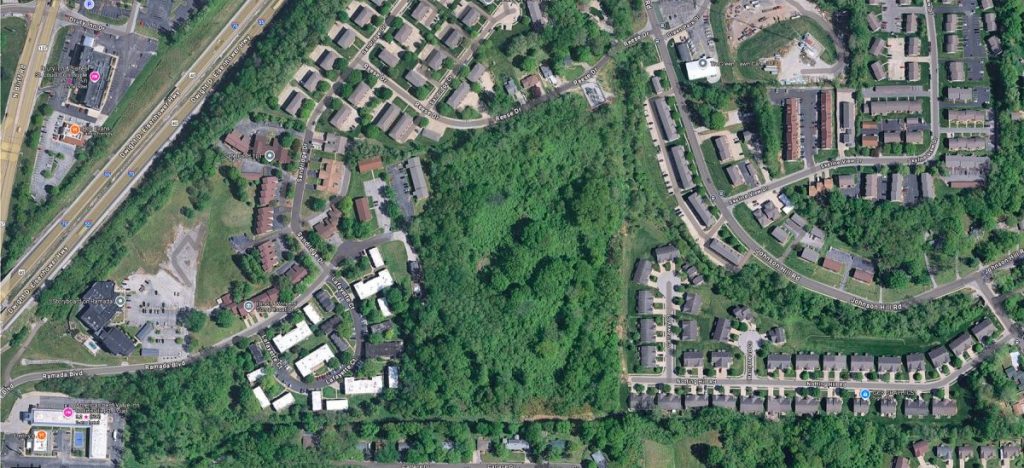
The greenspace in the center of the above image may possibly be the home of 96 one-bedroom apartments called Haven Hill Acres. The Collinsville Plan Commission tabled the request until September. (Google Earth image)
A 96-unit multi-family housing development has neighboring Collinsville residents up in arms.
The project, called Haven Hill Acres, is one of seven statewide that received funding from Governor J.B. Pritzker’s administration in May.
A full room of people attended a planning commission public hearing that took place July 10 at Collinsville City Hall. Collinsville City staff recommended approval of the project yet noted there are significant topographical challenges posed by the undeveloped woodlands on the site. The buildings are slated for the flattest portion of the site but there will still be a lot of grading required if this project becomes reality.
“At this point in time, the zoning petition is going through the process, which starts with a recommendation from the planning commission,” said City Manager Derek Jackson on July 10 before the meeting. “This evening, the request would be either approved as-is, approved with modifications, tabled or denied.”
Jackson added that the final vote will eventually be by the city council, unless the applicant hypothetically withdraws the petition before getting to council.
“The next meeting is scheduled for Aug. 14,” said Travis Taylor, the city’s community development director. “Note, however, we do not expect this to return until September, at best.”
At the end of the evening’s first public hearing, the commissioners agreed to table the developer’s request while city public works conducts a traffic study and safety analysis along with a drainage and soils report and while possibly a third-party contractor reviews the entire site plan.
Residents who oppose the plan and who sat through the almost-four-hour marathon meeting applauded the decision to lay it over for now.
The site was labeled multi-family in the city’s 2020 Comprehensive Plan and is believed to be suitable for multi-family development.
Owner/developer/property manager James Mundloch asked to combine three parcels into two and rezone them from R-3 Multi-Family to P-R-3 Planned Multi-Family District. Preliminary plat and site plan approval were also requested to permit the development of Haven Hills, a development on almost 19 acres at Ramada Blvd and Reese Drive. Total development and construction costs are estimated to be about $31 million. $7.5 million of that total will come from previously approved state and federal monies, he said.
After being sworn in, Mundloch got up to speak, quell rumors and address neighbors’ concerns.
“I am not part of Osborn Development,” he said. “I am simply purchasing this property from them. Osborn is not involved in this project whatsoever.”
He addressed what the project is, what it is not, the variances requested and other issues that have arisen since this development became quasi-public knowledge.
“It is not housing for illegal immigrants, it is not a homeless shelter, it is not a halfway house and it is not a recovery center,” Mundloch told the commission and the audience in the gallery.
He said the development is 96 conventional one-bedroom units in four buildings with a density of 10 units per acre. He added there will be screening on all four sides from part of the existing tree canopy.
He said the site would cater to conventional renters, senior citizen renters, renters with disabilities along with mixed incomes and a mixed population. Mundloch pledged to follow all state laws regarding housing and occupancy.
All applicants, regardless of background, must meet certain criteria, he said. Further, he pledged to make sure all leases are renewable annually and all units will be subject to occupancy permits and standards set by the city. Applications with three or more people listed would be denied, he said.
One commissioner was skeptical that the one-bedroom units will be confined to one or two people. Mundloch said if he found proof that more than two people lived in any unit, he would initiate eviction proceedings against them to limit the damage and the money he would later have to spend to repair the unit. Units would rent for around $1,200 per month with one-year leases, he told the commissioners.
Mundloch said school overcrowding was a common concern on social media. He said the average stat is 7.7 children per 100 one-bedroom units. He estimates the real estate taxes for this development is $210,000 annually. Fifty-eight percent of that amount or $122,000 annually or $17,500 per child would flow to the Collinsville School District.
During the public comment section, each speaker was sworn in then gave their name and address. The commission leader banged a gavel occasionally throughout the session to quiet the gallery comments. Ed. Note: the residents who spoke only said their names aloud. They did not spell them and no names were put on-screen, so name misspellings are possible.
“We have concerns about the people who would be in this community and about the traffic,” said Joseph Williams, who lived in a nearby condominium development. He recommended this be tabled indefinitely.
“I own a condo on Ramada Blvd. and across the street are three apartment buildings,” said Carol Justice. “There’s a lot of traffic, noise and people where I live. I do not want this place to become a ghetto.”
“I am speaking to you to offer my support for the Haven Hill project,” said Miriam Schlessinger. “We are living through a historic housing shortage in the United States and it is in Collinsville’s best interest to reverse this.” She spoke in support of a more diverse housing stock than just single-family homes.
“We’ve found drug paraphernalia in our yards and we have homeless people walking into our homes while we’re at home and things like that,” said Leila Anson. She said the city’s median income is where it is due to the glut of multi-family developments. She said if they had more single-family homes, the average median income would go up and the area would start to stabilize.
“The footprints from the buildings and the parking lots are going to increase [stormwater runoff],” said Jim Spagnon, a life-long Collinsville resident. “We don’t need any more water,” he said half-jokingly. He referred to the new road connection as ‘by-passing the by-pass.’ He said he believes this new development will only exacerbate existing issues in the vicinity.
“This is not about being against affordable housing, I understand its importance but building by wiping out one of the last untouched greenspaces in Collinsville isn’t just unnecessary, it’s reckless,” said Josephine Harris, a newer resident who moved to the area because due its history, nature and character that cannot be faked.
Senior Planner Caitlin Rice described site details. She said Notting Hill Court would also receive a proper cul-de-sac instead of the truncated street ending there now. A 10-foot-wide shared-use path would connect Notting Hill to Ramada and also serve as an emergency path for first responders.
Approximately half of the trees, shrubs, brush and grass would be cleared if this project passes with the city council’s blessing, she said. It was noted during the presentation that the previous Osborn project would have meant the entire site would have been denuded of vegetation while emphasizing that this project will not mean a total clearing, at least not for phase one.
Rice said first, an extension of Ramada to Reese would be built along with a private drive to the four buildings. All units are one-bedroom apartments and are ensconced with three-story dwellings with breezeways. Each building would have a community room, conference room, laundry area and office space. Mundloch added it was possible that he may make those communal spaces into storage lockers for the tenants instead.
One hundred forty-four parking spaces would serve the buildings and a shared-use path linking Ramada to Notting Hill Court, Rice said. All parking would be on-site with no street parking permitted. One-quarter of the lot area is required to be open space – the shared-use path, common areas around buildings and a conservation area with native plantings.
Contrary to some rumors, Rice said the project would not abut Willoughby Heritage Farm Park. There would be a buffer of at least 720 feet of private property between the two sites.
Mundloch requested three variances – first, 1.5 parking spaces per unit, a deviation from the city’s usual requirement of 2.5 spaces per unit, or a 126-space differential so as not to overpark the site and subtract from green space, or 1.25 additional acres to what is proposed. The commissioners also discussed raising the parking variance to 1.75 parking spaces per unit, or 168 total parking spaces.
Second, he requested a taller building height than typically required. The city’s maximum roof peak is 35 feet while 51.6 feet were requested. All four buildings would be the same height.
Finally, he requested 30% brick and 70% masonry siding versus 100% masonry for multi-family developments. City staff approved all three deviations.
A traffic study was not required by city staff as trip generations from the site did not pass the study threshold.
The verbiage in the city’s documentation listed 96 units total for the project but the site plan provided a different number – 112 units – two buildings would house 20 units, a third 24 units and the fourth would house 48 units. Building 1 would be covered by a grant from the Illinois Department of Housing Authority (IDHA), meaning 50% of units are for the disabled while no units can exceed 60% of the area median income or AMI. The average household median income for Collinsville is $65,000, Mundloch said. The median income for a single-income household is $39,000 or $18.75 per hour.
The above means that 10 units would be reserved for permanent housing for those with disabilities and 20 units would be reserved for those with a maximum income of $46,800 ($22 per hour) for singles and $53,520 ($25 per hour) for couples.
There may be a similar plan for the second lot but that is not being proposed at this time, city officials noted repeatedly during the public hearing.
“Today, my administration is reaffirming its commitment to housing equity by awarding $50 million to seven permanent supportive housing developments across the state,” said Pritzker in May. “Our critical investment will not only help Illinois’ most vulnerable residents achieve long-term housing stability, but it will also inspire hope by allowing people, regardless of illness or limitation, the freedom and dignity to live independently in settings appropriate to their own personal needs and preferences.”
Other Illinois cities that may offer developments similar to Haven Hill Acres include Jacksonville, Chicago, McHenry, Springfield, Villa Park and Wheaton.