Troy resident’s ‘73 Plymouth Duster is perfect siren call for spring
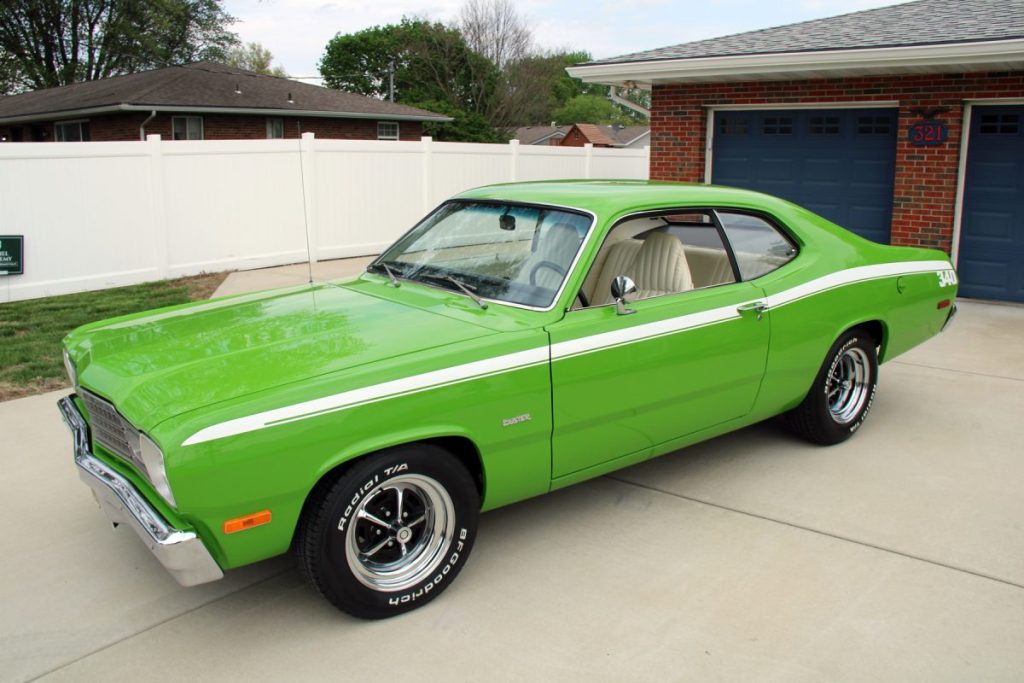
Pert and powerful, this 1973 Plymouth Duster has 340 CID V-8 under the hood, as the tape package indicates. This car was repainted Sassy Grass Green, one of Chrysler’s “mod” hues for the late 1960s and early 1970s. (Charles Bolinger photo)
By Charles Bolinger
Editor • Now that spring has sprung, what better way to open the new classic car season in this area than with this 1973 Plymouth Duster, dressed in Sassy Grass Green?
Four years earlier, Chrysler decided to rename its automotive paint palettes. Plymouth ended up with hues named, among others, Plum Crazy, Hemi Orange, Panther Pink, Go Mango, Butterscotch and Top Banana plus the aforementioned green.
“I think this color looks better on a cloudy day like this,” said owner and Troy resident Rick Muller on April 14. “The sun tends to wash it out.”
For those who forgot or did not know, the Duster was the two-door version of Plymouth’s popular Valiant compact, marketed from 1970 to 1976 and Plymouth was Chrysler’s entry-level, or value brand.
The Duster cashed in on the fastback styling craze that was popular in the late ‘60s and early ‘70s. For 1973, the Duster competed with Ford’s Maverick and American Motors’ Hornet along with Chevrolet’s Nova and to a lesser extent, the Pontiac Ventura II, Buick Apollo and Oldsmobile Omega. It also faced in-house competition from Dodge’s Demon, the two-door version of its compact car, the Dart.
This particular example was not always as it is now. It left Chrysler’s main assembly plant in Hamtramck, Michigan in October 1972 wearing Parchment inside and out, had a 225 CID Slant six-cylinder engine with a one-barrel carburetor under the hood and backed by a TorqueFlite A904 three-speed automatic transmission.
At some point in its life, a MOPAR (the portmanteau for Chrysler’s parts division) guy went searching for a rust-free Duster donor to turn into a project car. Finding a rust-free Plymouth Duster more than 50 years later is no small task but this man lucked out one day when a white, two-door Plymouth Duster was parked across the street. The seller’s grandmother owned it, finished in white or Parchment with matching upholstery.
The first changes the man made were to the engine and transmission. Out came the venerable Slant Six and A904, which he sold, and in went a 340 CID Light A (LA) V-8 with a four-barrel carb backed by a TorqueFlite A727 three-speed transmission. It has a shift kit with a stall convertor, Muller added.
Then he repainted it Sassy Grass Green, added the trim details and sold it to a guy in Damiansville, Illinois.
In the meantime, Muller bought another car in his fleet from one of two brothers, who lived at that time off of US 40 and Spring Valley Road.
“My brother’s going to be selling his Duster and it’s just as nice!” the man told Muller. Muller said he would check-in every six months with the man who sold him his 1966 Plymouth Satellite.
“After about a year-and-a-half, he says, ‘He’s decided to sell it!’” Muller said the other brother lived off of Interstate 64 in Damiansville, between New Baden and Okawville. Then he moved to a subdivision off of Troy-O’Fallon Road, about four miles south of Troy.
Muller had to wait a couple of weeks for the man to unpack his things and move into this new home.
Finally, on a Sunday afternoon, Muller got the phone call. “I knew when I pulled up, I was taking it home,” he said.
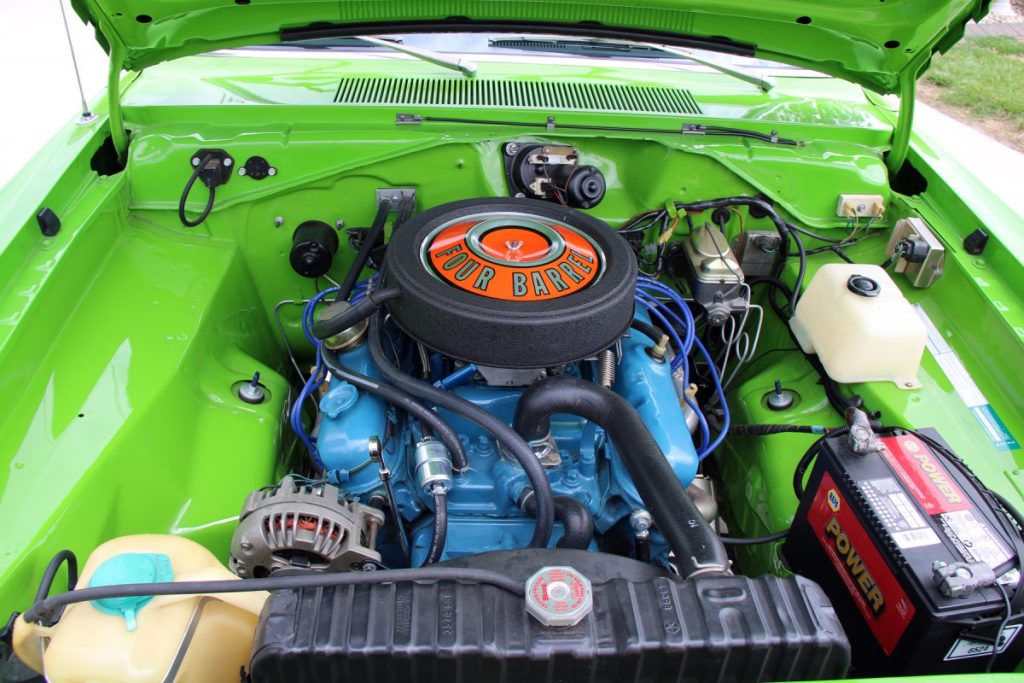
Note the absence of any convenience items under the hood – no air-conditioning, no power steering and no power brakes. This 340 CID V-8 engine with four-barrel carburotor was meant for racing, not cruising. (Charles Bolinger photo)
He’s owned the Duster for about nine months while the Satellite will have spent two years in his possession this summer, he said.
He said he doesn’t take the Duster out much. He called the seller a nice guy but ‘very particular’ because he wouldn’t allow Muller to touch the Duster’s paint with his bare hands before he bought it. He delivered the Duster to Muller’s storage area using his own, enclosed truck hauler, which made the process a snap.
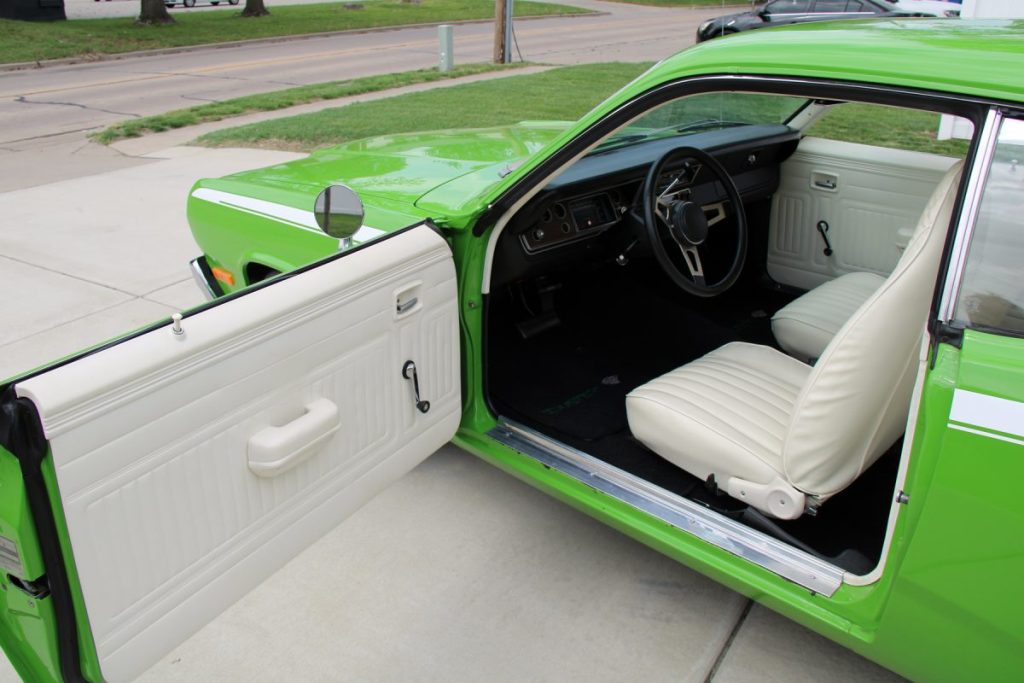
When he’s in the white driver’s seat of the Duster (which he said is a rare combination to find as most of them came with black vinyl buckets and rear bench seats), he receives a lot of attention from a certain group of folks.
“The MOPAR Guys really like it; they like the Sassy Grass Green,” Muller said.
Muller is a retired mechanic and these days, he said he doesn’t mind tinkering or tweaking his cars but he is no longer interested in frame-off restorations or anything laborious that also requires massive time and financial investments.
Muller said his family did not own a Duster when they were new but he remembered them from his days as a Kahok. He’s a 1973 graduate of Collinsville High School.
“In ‘69 and ‘70, guys would come out of the parking lot after school and just smoke the tires on the 340s, I mean they would just smoke the tires. That was so cool, y’know? We had one guy who had a Chevelle with a 454 V-8 in it and we had Dusters. For a 340, these engines wound up quick.”
He estimates that his Duster would outrun his ‘66 Satellite with a 383 CID V-8. He said the Duster’s lighter than his Satellite and the 340 motor revs freer than either Chrysler’s 360 or 383 V-8s. The Duster has a lumpy cam, which is most evident at idle.
He said he’s driven it to Collinsville and back twice for some maintenance and he goes to the Dairy Queen here in town for car cruises.
He said he spent three years working at the former Chrysler assembly plant in Fenton, Missouri, where he installed fuel tanks on the assembly line. He had to decipher the broadcast sheets correctly because he said there were three different gas tanks available with five different filler tube options, meaning a lot of possible combinations. He worked with his hands and arms over his head, installing the tanks and filler tubes while another employee strap-bolted the tanks in and connected the fuel lines to the tank.
He fired the Duster’s 340 up and let it idle. The old Chrysler Corp. starter sounded followed by a very lumpy camshaft heard clearly through the dual exhausts.
Following the design changes on the Valiant models, the Duster also received a new hood, grille, front fenders, bumpers and taillights for 1973. The taillights in previous years mounted from the inside and had a flush appearance. Starting in 1973, the taillights were mounted from the outside and were trimmed in chrome. These remained unchanged through 1976.
Other changes were in store for the Plymouth Duster. The 225-powered cars retained the five-lugs on a four-inch pattern on vehicles with the standard drum brakes. A three-speed Torque Flight automatic along with a manual transmission was offered with the 225 slant six. All models received larger front wheel bearings and increased spindle diameter. Electronic ignition became standard across the board. Ed. Note: this article originally ran in the April 23, 2026 issue of the Times-Tribune.