Collinsville gathering sheds light on local Revolutionary War History
By Randy Pierce • Collinsville, despite being hundreds of miles from the east coast of the United States, has a connection to the Revolutionary War, according to a local historian, which led to the nation’s independence, in the form of individuals who participated in it being buried or recognized in Glenwood Cemetery.
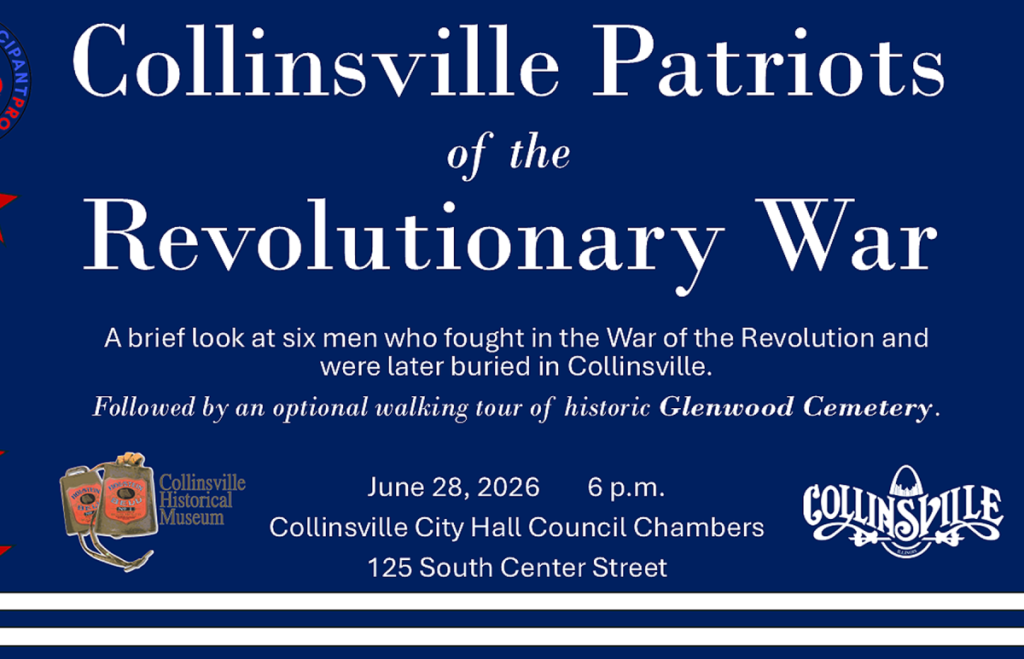
This information was the subject of focus at a public gathering held in the Collinsville City Council chambers on June 28, with Pete Stehman, manager of the local historical museum, serving as host.
Stehman explained that he was part of discussions concerning how the city could celebrate this year’s 250th Anniversary of the USA’s independence with the result being the community’s link to the war that led to it.
Lots of research conducted by the local Sons and Daughters of the American Revolution groups, Stehman said, revealed some pertinent details about the appropriate people buried at Glenwood Cemetery or those honored with some form of monument at this location.
Along with summarizing the experiences of those individuals, William Collins, Benjamin Johnson, John Long, Robert McMahan or McMahon, Elihu Mather and Henry Revis or Reavis, Stehman provided some related background about the troop movements, battles, conflicts and eventual relocation of the men he referenced to the Collinsville area.
Starting with the war’s first confrontations at Lexington and Concord, Stehman said there was about five years of fighting that ended with the surrender of British General Cornwallis at Yorktown in 1781, a half-decade after the approval of the Declaration of Independence by the Continental Congress.
The aforementioned named patriots were part of the Continental Army, Stehman said, which ranged in size from 120,000 to 231,000 troops, established by Congress and commanded by George Washington, engaged in most of the heavy fighting.
There was also a group of units called the Continental “Lines,” according to Stehman, which were established by a process of drafting men with each of the 13 Colonies required to contribute a specific number of soldiers. This militia-like group of 100,000 to 140,000 men, made up of state and local people, consisted of those who participated in the war effort on more of a part-time basis.
What brought those Stehman had identified to the then-far distant western frontier area of Illinois after the war was over were carts pulled by oxen, which moved at a rate of two or three miles per hour, in the late 18th Century. Illinois had become a state in 1818 with its population of 35,000, a number questioned by many as to its accuracy with the potential of it having been inflated.
To qualify as a state, Illinois did not have the required 40,000 people but it happened anyway, Stehman noted, with speculation that some of those who traveled here back then doing so by horseback.
The Collins Family, he said, arrived in late 1817, early 1818 then sent for their parents and sisters to join them four years later, most of them and the others coming from Connecticut or the region that included North Carolina and Virginia, the latter through what is called the Cumberland Gap in the Appalachian Mountains. Many of those going to the Midwest from New England went through where Wheeling, West Virginia is located.
Stehman explained that the Revolutionary War originated over dissatisfaction about taxes imposed by the British government with the battles being very costly and disturbing for the people in England due to the huge expense of the conflict.
“Keeping up with this attrition,” Stehman said, “keep pestering them, keep pestering them, at what point will the Brits decide enough, let them have their freedom?”
As an elder member of the family that founded this community, Private William Collins, later in his life, shared with his grandson that he was in Connecticut when part of a raid was conducted in New York. Twelve enemy vessels containing hay, grain and rum were destroyed. No patriots lost their lives in that action but many Brits died plus 96 more were captured and taken prisoner.
Collins additionally told his grandson about shooting a Mexican soldier who was working for the British, seeing the latter’s broken arm fly over his shoulder. Having been part of battles at Valentine’s Hill and Delong’s Hill in the northeast, Collins and his wife, the former Esther Morris, had 10 children and moved to this area in 1822.
Private Benjamin Johnson was a priest who came to Collinsville from Virginia, Stehman explained, after having marched to Germantown, Maryland and missing a battle that had concluded there but, subsequent to being drafted in 1777, had been denied a soldier’s pension, apparently because he had served only five months instead of the required six.
Records show that Johnson, who owned land in Collinsville, was buried at Glenwood Cemetery but the exact location is unknown. As late as 1840, Johnson was living with an individual named W.L. Harrison.
Both John Long, who later owned large tracts of land and ran a hotel in Collinsville, and Robert McMahan had fought at a skirmish at a courthouse in Guilford, North Carolina, an account of it indicating that the firing of 1,500 muskets in a straight-ahead march delivered a “crushing blow,” Stehman said, to the British troops, “one half of the Highlanders dropped on the spot.”
McMahan had actually been taken by the Brits as a prisoner, Stehman went on, but eventually moved to Lexington, Kentucky, got married then went to Monroe County in Illinois, where his wife and children were kidnapped by Indians. He remarried in St. Clair County and owned property in Collinsville, thusly resulting in Glenwood as a site to honor him.
Both McMahan and his daughter had also been captured in this area by Indians with him being able to escape but not her then purportedly being returned in Cahokia after a document called the Treaty of Greenville had been signed in 1795 in a town by that name in Ohio. He later remarried and settled in the Collinsville area.
Henry Revis, who is buried at Glenwood, came to this area from North Carolina where he was a member of the Continental Line militia serving a couple of terms of three months each as a young man, having been born in 1752, before coming to Illinois with his brother, buying 160 acres near or in what is now Maryville where St. John’s Cemetery came to be located.
Elihu Mather, who died in 1831, is the subject of a commemorative site at Glenwood which was constructed in his honor. He enlisted with the army of the patriots in Windsor, Connecticut on the first day of 1781 and served as a sergeant.
Mather eventually arrived in Madison County and owned property in Collinsville but the location of his burial has not been determined.